
Photo: @MÁS.INDEPENDENT
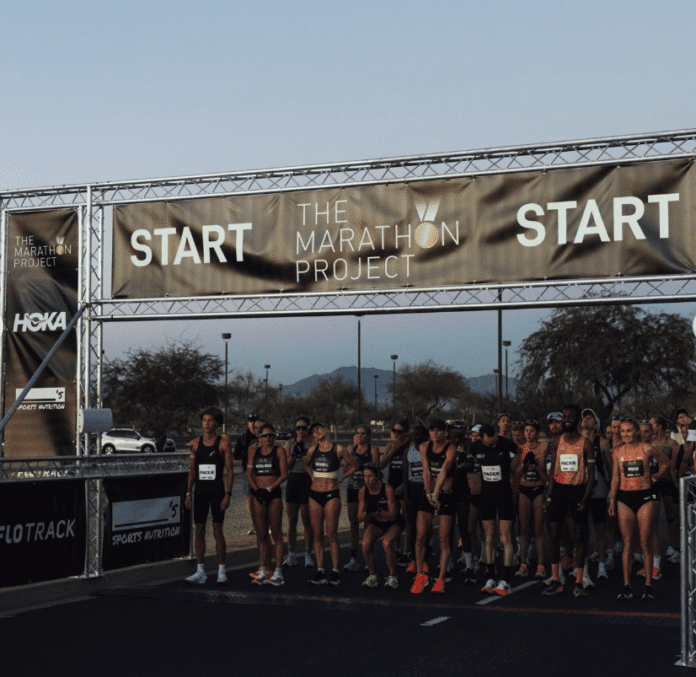
While the World Marathon Majors offer the prestige of historic city streets, The Marathon Project in Chandler, Arizona, offers something far more valuable to a professional athlete: the perfect environment for a breakthrough.
If you haven’t heard of it, that’s by design. The “Project” wasn’t built for the masses; it was built for the clock. As the 2025 racing season concludes, the results from the Arizona desert have sent a clear message—clinical efficiency is the new gold standard.
What is The Marathon Project? A High-Performance Speed Laboratory
The Marathon Project is a specialized, invite-only race engineered for one thing: mechanical efficiency. Launched in 2020 by industry veterans Ben Rosario and Josh Cox, it was a response to a world without sports. While other pandemic-era events faded, the Project became a permanent fixture as a “speed laboratory.”
The course is a flat, multi-loop circuit at the Wild Horse Pass. By stripping away the variables of a traditional city marathon—no bridges, no cobblestones, and no sharp turns—it creates a sterile environment where athletes can reach their absolute physical limit.
2025 Results: A Masterclass in Clinical Speed
On Sunday, December 21, the “Project” delivered two massive, career-defining wins that have reshaped the elite leaderboard heading into 2026.
JP Flavin’s Sub-2:10 Breakthrough
In the men’s field, JP Flavin of the Hansons-Brooks Distance Project executed a tactical masterpiece. Despite being nearly a minute back from the leaders at the 30k mark, Flavin methodically cut into the lead, passing stars like Paul Chelimo in the final miles to cross the line in 2:09:18.
This performance is a massive three-minute personal best, catapulting Flavin into the top tier of American marathoners. In a sport where sub-2:10 is the “golden ticket” for sponsorship and World Athletics standards, Flavin just punched his card.
Priscah Cherono’s Dominant Solo Effort
The women’s race was a different story. Priscah Cherono, the 45-year-old Kenyan veteran, made a hard move early, pulling away from pre-race favorites by the 30k mark.
Cherono stopped the clock at 2:25:17, a personal best by over two minutes. It was a high-wattage reminder that even in a “lab” setting, raw talent wins. Behind her, Molly Grabill (2:28:56) and Jane Bareikis (2:30:16) secured podium spots in a race that saw eight women finish under 2:36.
Editorial Analysis: Why the “Project” Model is the Future
We are entering an era where fans care more about “Super Times” than “Super Festivals.” The Marathon Project is the pioneer of this shift. It provides a service that traditional marathons simply cannot: Predictability.
-
Perfect Pacing: Professional rabbits focused on specific time goals.
-
Optimized Drafting: Pack running designed to minimize wind resistance.
-
Zero Friction: No crowd congestion or logistical hurdles.
For the serious runner, the Marathon Project is the most honest race in the world. There are no hills to blame and no tactical games to slow the pace. In Chandler, there is nowhere to hide.
Official 2025 Marathon Project Top Finishers
Men’s Elite
-
JP Flavin (USA) — 2:09:18 (PB)
-
Turner Wiley (USA) — 2:09:27 (PB)
-
Nadeel Wildschutt (RSA) — 2:09:40 (Debut)
-
Benjamin Rosa (USA) — 2:09:47 (PB)
-
Nicholas Hauger (USA) — 2:10:18
Women’s Elite
-
Priscah Cherono (KEN) — 2:25:17 (PB)
-
Molly Grabill (USA) — 2:28:56 (PB)
-
Jane Bareikis (USA) — 2:30:16 (PB)
-
Hanna Lindholm (SWE) — 2:31:19
-
Mica Rivera Wood (USA) — 2:31:35
Conclusion: A New Era for the 26.2
The success of the 2025 Marathon Project signals a permanent shift in how we define a “major” race. While the crowds of Boston and New York will always define the spirit of the sport, the Arizona desert now defines its limits. By stripping the marathon down to its mechanical essentials, organizers have created more than just a race; they’ve created a sanctuary for pure performance.
As we look toward 2026, the performances by Flavin and Cherono won’t just be remembered as wins—they will be studied as blueprints for what is possible when you remove the noise and just let the athletes run. In the quest for the perfect race, the “Project” has proven that sometimes, the best way to move the sport forward is to simplify it.