
If you have spent any significant amount of time logging weekly miles, the GPS watch conversation almost always defaults to a single brand. For years, the Garmin Forerunner series—particularly workhorse models like the Forerunner 965—has stood unchallenged as the gold standard for serious runners seeking advanced training metrics, brilliant AMOLED displays, and top-tier mapping capabilities.
However, the running tech landscape has shifted. Brands are beginning to realize that runners want premium, flagship-tier performance without having to finance a small vacation to afford it. Enter the Suunto Race S.
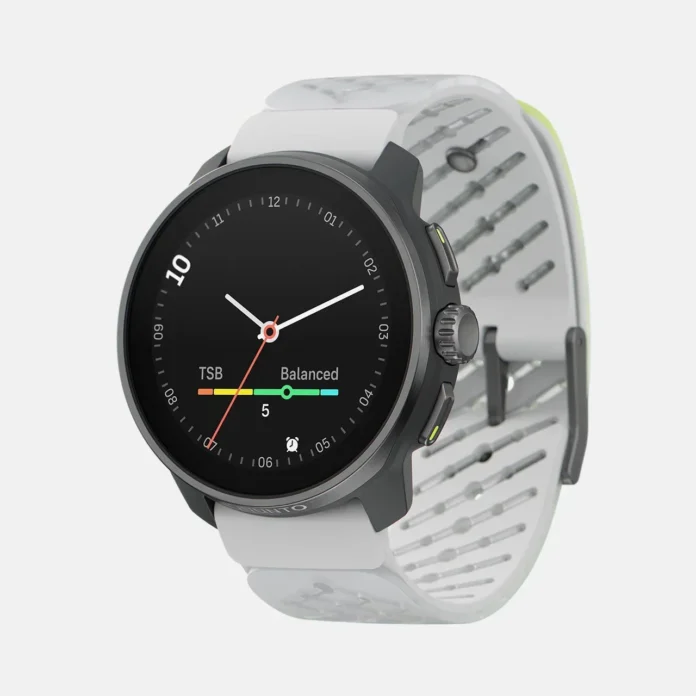
Priced aggressively between $279 and $349 USD, this smaller, lighter-weight 45mm performance GPS watch manages to pack almost all the heavy-hitting features of the original, bulkier 49mm Suunto Race into a sleek, highly accessible package. After putting it through a full year of rigorous training blocks, rainy long runs, threshold intervals, and race-day efforts, here is my comprehensive, runner-first breakdown of how the Suunto Race S handles the demands of a serious marathon build over time.
Key Specifications & Build Quality
- Price Point: Retails around $349 USD, though seasonal promotional discounts frequently bring it down closer to $279 USD, making it one of the most competitively priced performance watches on the market.
- Design & Sizing: Features a refined 45mm case (downsized from the original 49mm Race), a durable stainless steel bezel, and a comfortable, breathable silicone strap. Weighing in at roughly 50g, it feels remarkably lightweight and unobtrusive on smaller wrists, eliminating the wrist-bobble often associated with chunkier outdoor watches during long runs.
- Display Technology: A stunning 1.32-inch high-definition AMOLED touchscreen (466×466 pixels) protected by Gorilla Glass. Boasting a blazing 1,000 nits of brightness, it remains effortlessly readable even under harsh, direct midday sunlight.
- Navigation Hardware: Equipped with dual-band (L1+L5) GNSS tracking, free downloadable offline global topographical maps, and a responsive rotating digital crown.
- Battery Performance: Delivers up to 30 hours of continuous tracking in high-accuracy Performance GPS mode, stretching up to 40 hours in Endurance mode. For daily smartwatch usage, expect anywhere from 4 to 9 days depending on whether you utilize Always-On Display or gesture-activated modes.
The Runner’s Perspective: What Works Exceptionally Well After One Full Year
1. The AMOLED Display & Snappy Usability
When you are deep into a hard tempo run or navigating a complex downtown route, the last thing you want to do is squint at a dim screen or fiddle with a lagging menu. Over twelve months of daily wear, the 1.32-inch AMOLED display on the Race S has proven remarkably durable and vibrant, showing zero signs of burn-in. Paired with a heavily optimized user interface, flipping through data screens, checking split paces, and inspecting maps mid-stride remains wonderfully smooth. The physical inclusion of a rotating digital crown makes zooming in and out of topographic maps intuitive, though runners can easily toggle between the buttons and touchscreen depending on weather conditions or sweaty fingers.
2. Dual-Band GPS Precision
For marathoners logging high mileage across a mix of urban canyons surrounded by skyscrapers and densely tree-canopied park trails, GPS accuracy is non-negotiable. The Suunto Race S utilizes dual-frequency (multi-band) GNSS tracking. Throughout a full year of testing across varied weather conditions and changing landscapes, the watch locked onto satellites rapidly and maintained exceptional track fidelity. Even in tricky urban environments where older single-band watches typically drift into buildings or cut across streets, the Race S kept my splits and route mapping remarkably accurate week in and week out.
3. Free Offline Maps & Global Navigation
If your training block involves mapping out unfamiliar routes, exploring new towns while traveling, or tackling long weekend trail runs, the inclusion of free offline global topographical maps is an incredible value add. You get reliable breadcrumb navigation and streamlined turn-by-turn prompts that provide essential guidance without completely taking over your data screen. Getting lost is entirely optional, and having full maps right on your wrist during travel blocks over the last year has been a game-changer.
4. Training Load, Recovery, and Pacing Tools
Suunto’s broader software ecosystem provides robust tools for managing training stress, tracking recovery via nightly Heart Rate Variability (HRV) metrics, and evaluating sleep quality. Features like FusedSpeed utilize a clever blend of GPS and accelerometer data to deliver smooth, instantaneous current pace readings, eliminating the frustrating lag common in legacy GPS watches. Furthermore, software updates introduced Suunto Climb Guidance (akin to Garmin’s ClimbPro), which automatically detects ascents on rolling hills to give you real-time grade and climbing metrics when your legs need it most.
Where It Falls Short: The Cons & Limitations
No piece of running gear is entirely flawless, and living with the Race S through a full twelve-month training cycle highlights a few specific trade-offs to keep in mind:
- Optical Heart Rate (OHR) Consistency: While wrist-based optical sensors are entirely adequate for steady-state aerobic base miles and recovery jogs, the Race S sensor can occasionally struggle during fast interval sessions, track repeats, or sudden surges. Like many optical wrist sensors, it can show brief lag or erratic spikes when catching up to rapid heart rate changes. Serious marathoners who strictly train by heart rate zones for speedwork will definitely want to pair this watch with a dedicated chest strap.
- Battery Life Nuances: While the 30-hour high-accuracy GPS mode provides more than enough juice for a marathon and its post-race celebrations, daily smartwatch battery life is more modest. Expect closer to 4–5 days if you keep the Always-On Display enabled, though you can stretch it toward 7–9 days by switching to gesture-only activation.
- Lifestyle Omissions: If you are looking for a hybrid device to completely replace a high-end lifestyle smartwatch, you won’t find onboard music storage for offline streaming or contactless payment capabilities here. It is built strictly as a sports and performance tool.
- Crystal Durability: To keep the weight down and the price point remarkably low, Suunto utilizes Gorilla Glass rather than the heavy-duty sapphire crystal found on its larger sibling. After a year of heavy use, you’ll want to be slightly more mindful of potential scuffs if you frequently brush against rough rock surfaces or tight trail walls.
The Ecosystem Factor: Garmin Connect, Strava, and Moving On
A common hurdle for runners considering a switch from Garmin is the comfort of the ecosystem. Let’s be honest: we love Garmin Connect for its deep data dives, badges, and long-term historical tracking. However, when it comes to what we actually rely on day-to-day for community engagement, segment hunting, and holistic training logs across different devices, our ultimate source of truth is Strava. The beauty of the modern running tech landscape is that hardware brand loyalty doesn’t have to lock you into a single app ecosystem—any watch, including the Suunto Race S, seamlessly connects and exports your data directly to Strava.
The Verdict: How Does It Stack Up After a Year?
For runners deeply entrenched in the Garmin ecosystem—specifically those eyeing mid-to-high-tier options like the Forerunner 965—the Suunto Race S presents a genuinely compelling dilemma.
After a full year of putting it through every imaginable test, it is clear that if you have been holding out for a gorgeous AMOLED screen, elite dual-band GPS accuracy, and comprehensive mapping tools without having to drop $600 or more on a flagship watch, the Suunto Race S punches vastly above its weight class. At its street price point, the value proposition is nearly impossible to ignore.
Bottom Line: Strap on a chest strap for your track intervals and hard threshold days, connect your account to Strava, and the Suunto Race S transforms into an exceptionally capable, budget-conscious training partner for your next marathon starting line.