
What was supposed to be a flat, fast half-marathon in Northern New Jersey turned into an amphibious survival exercise on Sunday, September 13, 2026, as hundreds of runners navigated waist-deep flash floodwaters along the Saddle River. Advertised as a personal-record-friendly course winding through Bergen County’s Saddle River County Park, the Racefaster Half Marathon quickly became the subject of intense social media outrage and safety debates when torrential downpours converted low-lying underpasses into rushing torrents.
From Fast Track to Flood Zone
Saddle River County Park features a paved six-mile multi-use trail running from Ridgewood through Paramus down to Rochelle Park. The path crosses underneath several major roadways and bridges—geographic low points that lie directly alongside the Saddle River.
On Sunday morning, a fast-moving storm dumped 2 to 3 inches of rain across northern New Jersey in a matter of hours. At 8:53 a.m., more than an hour before the race started, the National Weather Service issued a Flash Flood Warning specifically naming Paramus and Fair Lawn, warning of life-threatening flash flooding.
Despite the active flood warnings and rising water levels, event organizers made the decision to push back the original 8:00 a.m. start time to 10:00 a.m. rather than canceling or re-routing the event.
For many participants, the two-hour delay seemed like a standard weather mitigation effort.
“I’m like, I guess it’s gonna rain… it sounds like a good, logical decision,” runner Garrett Nathan told NBC New York. “I keep checking my email from the race directors and get no notifications about a canceling.”
“Bro, This Is Nuts”
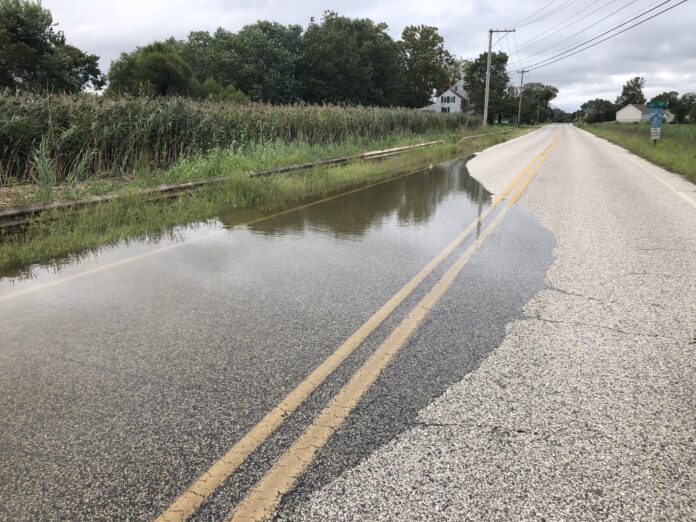
Once the field set off, conditions degraded rapidly. The Saddle River swelled past its banks, inundating the trail’s bridge underpasses with murky, fast-moving water.
Participants were forced to make a choice: turn around, or wade directly through. Photos and videos shared across social media showed runners submerged to their waists, clinging tightly to handrails as floodwaters surged past.
Former Bachelorette contestant Zac Clark posted a video to Instagram (@zwclark) while navigating a flooded portion near Red Mill Road:
“Bro, this is nuts,” Clark exclaimed in his video while recording runners wading through the torrent. His caption later noted, “Many rivers were crossed.”
Runner Emily Smolenski recounted wading through the underpasses in clusters, telling the Daily Voice:
“Thankfully I was in a group each time I went under those bridges otherwise I wouldn’t have gone through.”
Other participants reported even more severe conditions. Runner Matthew Vickers told KARE 11 (TEGNA) that he and his cousin had to assist an elderly runner caught in chest-deep water:
“She was perpendicular in the water doing a swimmers kick, and we dragged her out,” Vickers said, describing the scene as a “complete disregard for our safety.”
Backlash, Safety Regs, and the Regulatory Void
While some runners treated the situation with gallows humor, the online reaction from the running community was swift and furious.
- Calls for Cancellation: “Jokes and perseverance aside, the organizers 100% needed to call this race. So unsafe and I hope no one got hurt,” runner Claire Holt commented on Instagram.
- Safety & Rescue Perspectives: Jeff Le, a search-and-rescue swiftwater technician and fellow race director, pulled no punches in a public social media comment cited by Marathon Handbook: “As a race director and SAR swiftwater tech, this is extremely negligent and dangerous. Hard no even for a trail race.”
The incident highlights a surprising blind spot in race safety frameworks. As reported by Marathon Handbook, while organizations like the Road Runners Club of America (RRCA) maintain clear policy thresholds for extreme heat, dew point, and air quality in their Safe Event Guidelines, their safety guidelines make no explicit mention of floodwaters or flash floods. Instead, standard guidelines rely on race directors to exercise “common sense” in coordination with local authorities.
The Aftermath
Approximately 250 runners ultimately crossed the finish line according to NBC New York reporting. Remarkably, no major injuries were reported.
However, as the Saddle River continued to rise hours after the event—peaking at 6.8 feet (more than a foot above flood stage)—questions remained. Local outlets report that county officials have launched a review of the event, and Racefaster has not publicly responded to requests for comment regarding why the race proceeded amid active flash flood warnings.
For the runners who braved Sunday’s event, they may not have set the personal records they trained for—but they certainly walked away with an unforgettable race day story.