As major marathons across the globe strive to reduce their environmental footprint, the 2026 Bank of America Chicago Marathon took a massive step forward this year by debuting on-course, self-serve water refill stations. Powered by Culligan Water and backed by official vendor partner HydraPak, the pilot initiative offered tens of thousands of runners a sustainable alternative to traditional single-use paper cups.
The results are in, signaling a potential shift in how distance runners approach race-day fueling.
By the Numbers: Chicago’s Refill Pilot Success
According to post-race data provided by event organizers:
- 32,195 participants utilized one or more Culligan Water Refill Stations on course—representing nearly 60% of the entire race field.
- 3,814 gallons of filtered water were dispensed across the pilot stations.
- 122,048 single-use paper cups were eliminated directly through the pilot.
“As with every on-course innovation, we listen and apply insights to ensure we create the most optimal experience for runners,” Chicago Marathon organizers shared with Marathon Journal. “We saw strong engagement as nearly 60 percent of the 2026 Bank of America Chicago Marathon field engaged with at least one Culligan Water Refill Station… The impressive year-one response indicates runners are open to embracing new hydration approaches while reducing reliance on single-use cups.”
Chicago’s rollout builds on early refill station trials at the TCS London Marathon and arrives just weeks ahead of the TCS New York City Marathon’s own scheduled Culligan deployment—confirming that runner-carried hydration is rapidly transitioning from a niche habit to an Abbott World Marathon Majors mainstay.
How the On-Course Refill Stations Worked
Located at four strategic points along the course—Mile 5.7, Mile 10.1, Mile 15.7, and Mile 20.3—the stations were designed to operate seamlessly alongside traditional aid stations without disrupting traffic flow.
Positioned behind barricades on one side of the course, each station functioned much like a dedicated highway pull-off lane:
- High-Visibility Footprint: Marked by tall, bright blue Culligan “Refill Station” flags positioned just ahead of traditional Gatorade and water tables.
- Fast-Fill Spouts: Built into heavy-duty vertical signboards, the mechanical high-flow push spouts allowed runners to dock their handheld bottles or soft flasks and top off in just 1.3 to 2 seconds under high water pressure.
- Traffic Isolation: By placing stations behind a row of fencing, stopping runners were completely separated from those continuing along the main running line.
Field Test: Running Chicago with HydraPak
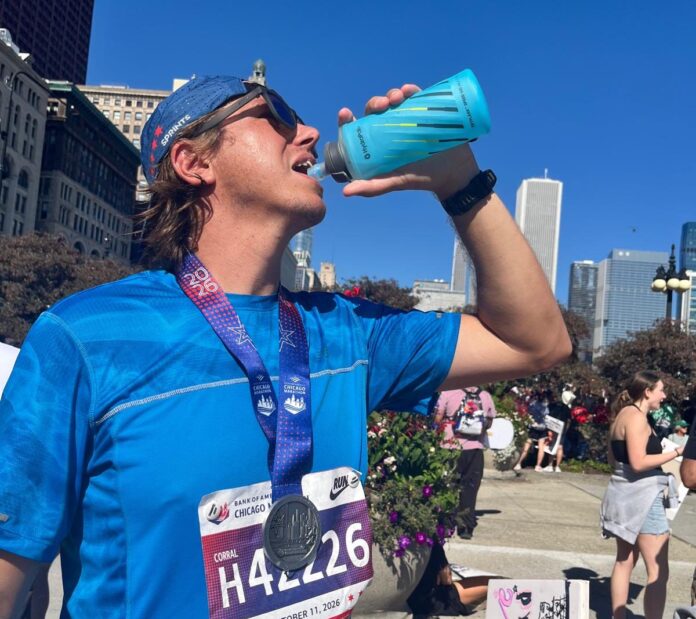
To evaluate the real-world performance of the refill system during a high-stakes marathon, Marathon Journal staff member Federico “Fede” Burger ran the Chicago Marathon equipped with a HydraPak soft flask with a hand strap (provided via our media partnership with HydraPak).
Fede not only tested the stations across all 26.2 miles, he walked away with a brand-new Personal Record (PR).
1. Speed, Flow, and Station Efficiency
Going into race day, Fede admitted to initial worries about congestion among 55,000 runners and potential time lost at refill stops. In reality, the execution was practically instantaneous:
“I was worried about the logistics of keeping running or stopping and refilling… but honestly, it was the opposite. It was very easy. Took me literally three seconds… Press the button, literally one second was full of water, close it and keep running. That helped me a lot also to do the PR, because I spent no more than three seconds.”
Because the stations catered primarily to runners carrying bottles or flasks, the lines were virtually non-existent:
“All the time the water stations were empty for me… When I was running next to the cups, I saw the guys stopping longer than me because it was full of people, they were pushing each other. On this one, I was drinking whenever I needed it, not when they gave me the option.”
2. Managing Electrolytes on the Move
Carrying a dedicated 600ml soft flask allowed Fede to execute a precise fueling strategy coordinated with his coach, mixing water, caffeine gels, and salt tablets directly on course without stopping:
“This bottle is perfect for that because I had my tablets in the pockets and I open it, drop the tablet, close it and keep running. I didn’t have to stop. I did that while I was running.”
3. Real-World Lessons: Ergonomics Matter
While the lightweight soft flask eliminated the extra weight of a vest or the bounce of a hydration belt, Fede shared one crucial piece of advice for prospective runners: switch hands during the race.
“Something that I didn’t do during the race, and that’s my mistake, is opening the strap and switching hands once in a while. I was running the whole race with the bottle only in my left hand… I had some soreness in my shoulder, but that was on me! Overall, I had a great experience.”
Pondering the Future: What If Every Runner Went Cupless?
Fede’s flawless experience highlights the immense promise of hybrid hydration, but it also raises a crucial question for race directors and sports scientists: What happens if all 55,000 runners adopt this method?
While the pilot was smooth for 32,000 users, scaling to 100 percent runner adoption would present unique operational challenges:
- Massive Bottlenecks: With 40 percent of the field still grabbing traditional cups, traffic at the Culligan hubs moved quickly. If 55,000 runners suddenly needed to refill, four stations would quickly overflow. Race organizers would have to expand station footprints into massive multi-lane deceleration zones to avoid human traffic jams.
- Cultural Adaptation: Road marathons have long accustomed runners to hand-to-mouth cup service. Going fully cupless demands self-reliance, requiring runners to train with gear months in advance to master carrying weight and avoid localized muscular fatigue like Fede’s shoulder soreness.
The Chicago Marathon’s hybrid model proves that sustainability and elite performance can coexist on a World Marathon Major course. By pairing Culligan’s rapid-fill infrastructure with runner-friendly gear like HydraPak soft flasks, major races can drastically cut paper waste while giving runners total control over their personal hydration strategy. Scaling this model into a universal standard will be the next great challenge for race organizers worldwide.