
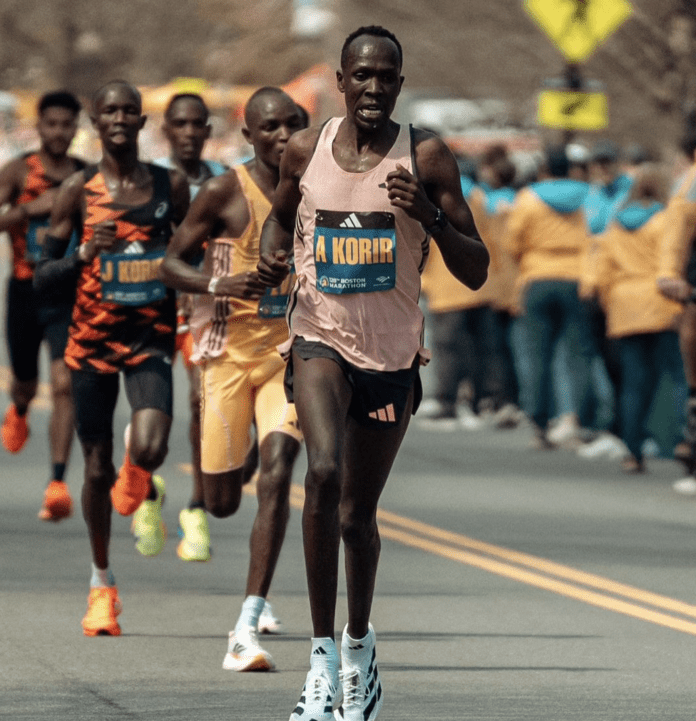
The distance running world was rocked this morning as the Athletics Integrity Unit (AIU) officially added a heavyweight name to its Provisional Suspensions in Force list: Albert Korir.
The 31-year-old Kenyan star—a name synonymous with tactical brilliance and podium consistency—has been sidelined following a positive test for CERA, a potent third-generation form of EPO. While the AIU’s disciplinary process is ongoing, the imposition of a provisional suspension is a significant legal step under the World Athletics Anti-Doping Rules. It immediately bars Korir from all competition, training camps, and official athletic activities while the case is adjudicated.
The Streak in Jeopardy
To understand the weight of this news, one only needs to look at the results from the “Capital of the World.” Since winning the New York City Marathon in 2021, Korir had become the king of consistency on the five-borough course.
His resume over the last three years in New York reads like a masterclass in elite racing:
2023: 3rd Place (2:06:57)
2024: 3rd Place (2:08:00)
2025: 3rd Place (2:08:57) – Just two months ago
For an athlete to find the podium in Central Park three years running is a feat of legendary proportions. Now, with his name appearing on the AIU’s list of suspended athletes for violations of Article 2.1 and 2.2, fans are forced to wonder if this “Ironman” consistency was fueled by the long-lasting effects of CERA.
The Ottawa Implications: Justice for Rory?
While the NYC results carry the prestige of the Majors, the most immediate “reshuffling” of the record books will likely happen north of the border.
In May 2025, Korir claimed victory at the Ottawa Marathon in 2:08:22. It was a race defined by a nail-biting finish, as Canada’s Rory Linkletter mounted a furious late-race charge. Linkletter finished just 9 seconds behind Korir, clocking 2:08:31—the fastest time ever recorded by a Canadian on home soil.
Under AIU and WADA (World Anti-Doping Agency) rules, a final finding of guilt would result in the automatic disqualification of results dating back to the point of the violation. If Korir’s victory is vacated, Linkletter—a vocal advocate for clean sport—would be elevated to the top of the podium.
WADA Context: The Strict Liability Principle
The presence of CERA in Korir’s sample triggers the WADA “Strict Liability” principle. Under this fundamental rule of the World Anti-Doping Code, an athlete is responsible for any substance found in their body, regardless of how it got there. Proof of intent, fault, negligence, or knowing Use is not required to establish an anti-doping rule violation.
Because CERA is classified as a “non-specified substance” on the WADA Prohibited List, the provisional suspension is mandatory. Unlike “specified substances” (which can sometimes be found in contaminated supplements), CERA is a sophisticated blood-booster with no accidental path into an elite athlete’s system. Under current WADA guidelines, a confirmed violation for CERA typically carries a four-year ban.
Analysis: A System Under Fire
This latest bust comes at a time when Kenya remains under intense scrutiny as a “Category A” nation—a designation reserved by World Athletics for countries with the highest doping risk. The AIU’s “Suspensions in Force” list has grown increasingly crowded with Kenyan names, but few carry the profile of a former New York City champion.
The choice of CERA is particularly telling. Unlike traditional EPO, CERA (Continuous Erythropoietin Receptor Activator) has a much longer half-life, staying in the system for weeks. Its appearance here suggests a level of sophistication that the AIU’s increasingly sensitive testing protocols are finally catching up to.
What’s Next?
A provisional suspension is the first step in a formal disciplinary process. Under the International Standard for Results Management (ISRM), Korir now has the right to:
Request a B-sample analysis to confirm the finding.
Provide an explanation for the Adverse Analytical Finding (AAF).
Request a hearing before the independent Disciplinary Tribunal
If the ban holds, the “Albert Korir Era” is over. The record books will be scrubbed, prize money will be reclaimed, and the podiums will be shifted. But for the fans who cheered in Central Park and the runners like Rory Linkletter who chased him down the Rideau Canal, the damage to the sport’s integrity will take much longer to heal.