
The BMW Berlin Marathon 2026 has earned its legendary status through a predictable formula of lightning-fast asphalt, ideal autumn conditions, and world-class fields capable of rewriting record books. Yet, the 2026 edition proved that even the most calculated race plans can transform into high drama on the streets of the German capital.
From Guye Adola’s calculated masterclass in the men’s division to Tigst Assefa’s agonizing, valiant defense of her lead in the women’s race, Sunday’s event delivered an unforgettable showcase of tactical brilliance and pure physical resilience.
Adola Secures the Crown in a Men’s Tactical Thriller
While much of the early pre-race buzz centered on the world record attempts, the elite men’s race unfolded as a masterclass in patience and tactical execution.
A dense, high-caliber lead pack refused to fracture through the early miles, passing the 10km mark in 28:58 and hitting the halfway point locked together at 1:01:01. Contenders such as Selemon Barega, Getaneh Molla, and Tanzania’s Gabriel Geay all shared the burden at the front through the early stages.
As the race pushed past the 30km mark (1:26:57), the dynamic shifted. Adola, operating with veteran poise on a course where he famously finished second to Eliud Kipchoge on his marathon debut nine years prior, initiated a decisive surge.
Shedding his primary challengers over the next five kilometers, Adola opened a commanding gap. He crossed the finish line in a blistering personal best of 2:02:50, shaving nearly a minute off his previous career best. The victory marks his second Berlin title, following his 2021 triumph, and caps off a stellar season that also featured a victory in Rotterdam.
Compatriot Gemechu Dida finished second in a strong 2:03:19, while Gabriel Geay rounded out the podium for Tanzania in 2:03:59. Getaneh Molla secured fourth in 2:04:55, just ahead of Selemon Barega in 2:04:58.
Assefa’s Record Bid Ends in a Test of Pure Grit
In the women’s race, Tigst Assefa provided one of the most compelling narratives in modern distance running.
Assefa separated herself from the field early, hitting 5km in 15:30 and expanding her lead over reigning champion Rosemary Wanjiru with every kilometer. Her progression through the first half was nothing short of historic, culminating in a 1:04:57 halfway split that stands as the third-fastest half-marathon time ever recorded in a women’s race.
Maintaining world-record pacing past 30km (1:32:15), she shockingly accelerated between 30km and 35km with a 15:17 split. By the 40km checkpoint (2:03:00), a world-record finish appeared all but certain.
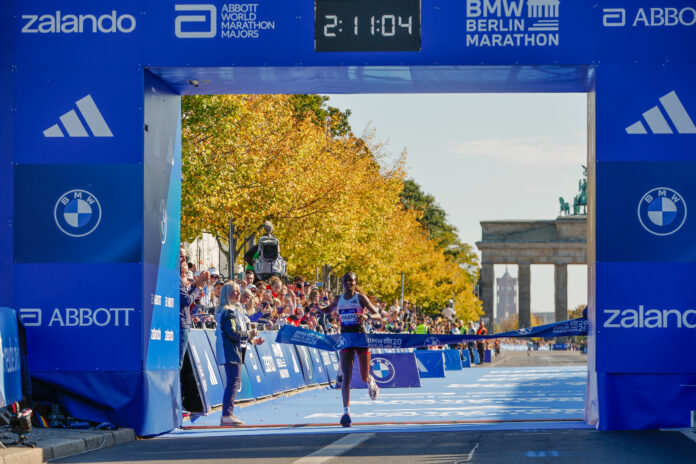
Then, the race turned. Almost immediately after 40km, Assefa experienced a sudden physical breakdown, running with a pronounced limp and severe discomfort. Holding a massive cushion over the rest of the field, her immediate battle shifted from chasing history to simply finishing. Displaying remarkable resolve, she pushed through the pain to cross the line in 2:11:04.
While missing the world record, the performance stands as the third-fastest women’s marathon in history, breaking her own previous Berlin course record by 49 seconds and sealing her third career victory in the city. Bedatu Hirpa took second in 2:16:53, closely followed by Dera Dida in 2:16:55.
Elite Wheelchair Divisions Deliver Dominance
The professional wheelchair races also provided elite performances on the flat course.
In the men’s division, Switzerland’s legendary Marcel Hug dominated the field, securing victory in a commanding 1:23:28. Sho Watanabe of Japan and Lito King Anker of the Netherlands crossed next in a tight battle for the remaining podium spots, both timed at 1:29:26.
In the women’s wheelchair competition, Switzerland continued its sweep as Catherine Debrunner took the tape in 1:35:01, followed by compatriot Manuela Schär in 1:41:53, with Great Britain’s Eden Rainbow-Cooper taking third in 1:44:51.
Final Thoughts
The 2026 BMW Berlin Marathon reinforced why the sport captivates millions. Between Adola’s tactical execution to capture the men’s crown and Assefa’s heartbreaking yet heroic battle down the stretch, the event offered a reminder of both the fragility and extraordinary potential of elite endurance racing.