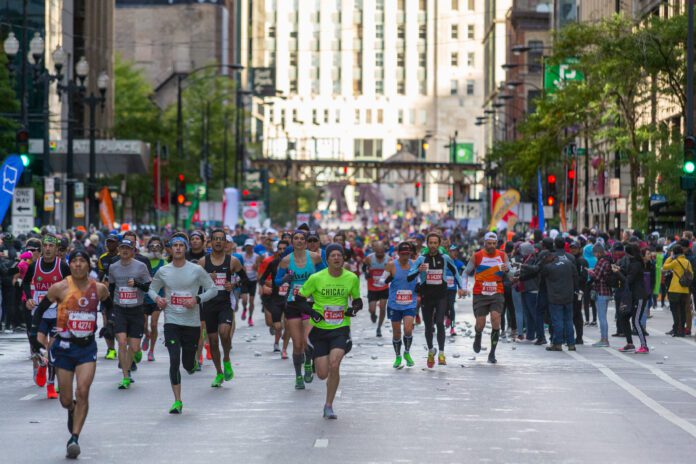
When the 48th Bank of America Chicago Marathon kicks off on Sunday, October 11, 2026, it won’t just mark another edition of one of road racing’s most celebrated events—it will set a new high-water mark for participation. Race organizers have officially announced Chicago Marathon’s record-breaking field of more than 55,000 registered runners, making the 2026 race the largest in Chicago Marathon history.
This milestone arrives alongside unprecedented global demand for distance running, where major marathons are expanding their footprints to keep pace with an international running boom that shows no signs of slowing.
By the Numbers: The Scale of Chicago’s Expansion
The jump to 55,000 registered runners reflects both the relentless appetite of distance runners and the logistical evolution of city marathons.
- 55,000+ — Registered participants for the 2026 race (surpassing previous field caps).
- 52,150 — Chicago’s current finisher record, set in 2024.
- 160,000+ — Applicants for the race lottery, illustrating an acceptance rate under 35%.
- 29 — Distinct Chicago neighborhoods traversed along the 26.2-mile course.
- $756 Million+ — Estimated annual economic impact generated for the City of Chicago.
While the 55,000 figure represents total registrants rather than final finishers (which typically run slightly lower due to injuries and DNS stats), the size of the field highlights how organizers are maximizing urban infrastructure, wave starts, and course management to safely host more runners than ever before.
Behind the Bibs: Remarkable Stories Fueling the 2026 Race
Beyond the sheer numbers, the heart of the Bank of America Chicago Marathon remains its human element. Bank of America’s official field announcement showcased a diverse slate of participants whose stories capture the endurance, resilience, and purpose driving modern distance runners:
1. The Chicago Legends & Streak Keepers
- Randy Burt (78) & Henry Kozlowski (76): Unbroken since the inaugural race on September 25, 1977, Burt and Kozlowski are the only two runners who have completed every single Chicago Marathon (47 to date). Lineup #48 puts them just two years away from a historic 50th consecutive finish.
- Timothy Gross (70): Ran the original Mayor Daley Marathon in 1977 as a 20-year-old, took a multidecade break, and returned in 2016 after losing over 70 pounds. Now deaf and nearing 70, Gross ran a 3:40:35 in 2024 and targets another personal best for his 10th Chicago finish.
- Joabe Barbosa: The first person documented to run every single street in Chicago—covering 4,000+ miles across all 77 community areas—will complete his Chicago Distance Series sweep in support of local non-profit My Block, My Hood, My City.
2. Sports & Celebrity Champions
- Anthony Rizzo & Jake Arrieta: 2016 Chicago Cubs World Series champions return to the city. Rizzo, a Hodgkin’s lymphoma survivor, will run to raise funds for the Anthony Rizzo Family Foundation alongside his former teammate Arrieta.
3. Inclusion, Advocacy, and Record Chasers
- Guy Conners (Runner 321): Representing neurodivergent athletes, Conners—diagnosed with autism in childhood and an accomplished ultramarathoner—will wear the designated Bib #321 as part of the Runner 321 inclusion movement.
- Jacob Nur (70): Multiple USATF and world age-group record holder, Nur is targeting Chicago’s notoriously fast, flat course to break the M70–74 world marathon record.
- Mykensie Halily: Nurse and para-athlete running through MS, cancer recovery, and personal loss alongside her sister as an act of healing.
Marathon Journal Analysis: What Chicago’s Record Means for the Sport
1. The “World Marathon Major” Effect and Ballot Inflation
Chicago’s growth is part of a broader macro-trend across the Abbott World Marathon Majors (WMM). With Sydney joining as the 7th Major in 2025, the demand for the “Seven Star” journey has created severe ballot inflation worldwide:
- London Marathon: Set an all-time world record in April 2026 with 59,830 finishers following over 1.1 million ballot applications.
- New York City Marathon: Finished 59,226 runners in late 2025.
- Sydney Marathon: Saw applications surge 56% in 2026 to over 123,000 prospective runners.
As millions of runners pursue major marathon bucket lists, general entry lotteries have turned into high-stakes sweepstakes, leaving race directors to balance access against safety and course density.
2. The Operational Tightrope: Managing Bottlenecks at Scale
Pushing a field past 55,000 is an immense operational undertaking. Unlike courses with narrower trails or severe bottlenecks, Chicago’s wide boulevards and flat profile give it a structural advantage. However, scaling up requires:
- Wave Start Engineering: Staggering start times to prevent congestion in early miles, at aid stations, and across narrow bridge crossings.
- Hydration & Medical Scaling: Logistics teams must scale medical tents, fluid distribution (water and Gatorade Endless Performance), and gear check operations proportionally.
- Community Integration: Closing major arteries across 29 neighborhoods for up to eight hours requires precise coordination with city transit, emergency services, and community boards.
3. Purpose-Driven Running as the Main Growth Engine
The profiles highlighted by race organizers reflect a permanent shift in marathon culture: charity and personal narrative are now equal to performance. While elite runners chase world records in Grant Park, thousands of charity spots allow runners to bypass lottery odds while raising tens of millions for global and local causes.
Looking Ahead to October 11
As the countdown to race day begins, the 2026 Bank of America Chicago Marathon stands as a testament to the enduring power of 26.2 miles. Whether chasing an age-group world record like Jacob Nur, honoring a 48-year streak like Randy Burt and Henry Kozlowski, or taking on a first marathon after overcoming adversity, 55,000 runners will prove once again why Chicago remains one of the premier capitals of the running world.