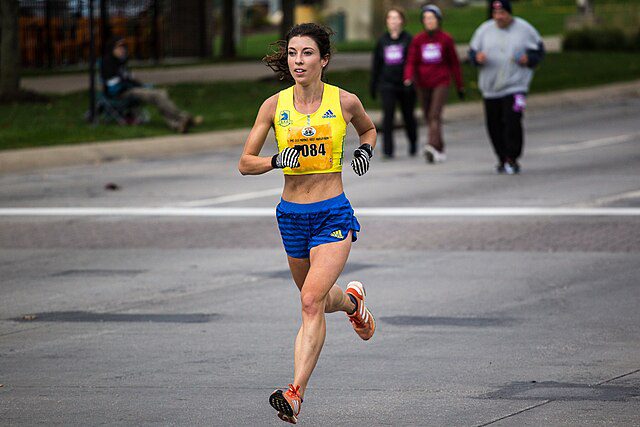
The running world is currently centered on a developing dispute between American marathon star Emma Bates and her longtime nutrition sponsor, UCAN. On Tuesday, Bates posted a video to social media sharing new fueling products she has been testing, explicitly stating that UCAN “dropped” her after she informed them of her pregnancy.
Bates, 33, recently announced she is expecting her first child and will not be competing in the 2026 Boston Marathon. Her partnership with UCAN had spanned four years, a period during which she became one of the fastest American women in history, notably clocking a 2:22:10 at the 2023 Boston Marathon.
In response to the public allegations, UCAN has provided a detailed timeline of the negotiations, asserting that the decision to restructure Bates’s deal was a result of standard business planning and was initiated months before they were aware of her pregnancy.
The Timeline According to UCAN
According to UCAN’s partnerships team, the decision-making process began in September 2025. The company states they internally determined a need to rework 2026 partnership agreements, including the contract for Bates.
- October 2025: UCAN began discussions with Bates’s representation regarding a revised contract structure.
- November 2025: UCAN reportedly offered a revised agreement featuring a lower rate and reduced deliverables. This offer was rejected by Bates’s team, who requested she remain at her previous contract level. UCAN emphasizes that this negotiation took place before they were informed of the pregnancy.
- December 2025: Further discussions occurred regarding alternative structures. UCAN claims no final offers were reached during this stage and suggests there may have been a “good-faith misunderstanding” regarding whether these discussions constituted a firm offer.
- December 18, 2025: UCAN was officially informed of Bates’s pregnancy. The company maintains this did not change their existing negotiation position.
- January 2026: UCAN made a final offer, which they state was at the same level as the offer made in November. The offer was rejected, and the partnership subsequently ended.
UCAN noted that while her contract expired in December 2025, they provided a pro-rated payment for January 2026 as a gesture of good faith.
Conflicting Reports and Industry Context
The timeline provided by UCAN contrasts with statements from Bates’s agency, Flynn Sports. As reported by Front Office Sports, representative Matt Sonnenfeldt claimed that UCAN’s account is not entirely accurate, stating that the company “made an offer in December and then changed it.”
The dispute has sparked intense discussion on platforms like LetsRun regarding the protections—or lack thereof—for pregnant athletes. While some sponsors, such as Bates’s shoe sponsor ASICS, have public-facing policies that protect athlete compensation during pregnancy, many nutrition and secondary sponsors operate under different contractual frameworks.
The “Independent Contractor” Reality
This dispute highlights a massive legal loophole in professional sports. Because runners are classified as independent contractors, they are not protected by standard employment laws regarding pregnancy discrimination.
While the “Allyson Felix Effect” in 2019 forced major shoe brands like Nike and ASICS (Bates’s primary sponsor) to adopt formal pregnancy protections, those policies rarely extend to “secondary” sponsors like nutrition, hydration, or apparel accessories.
For a brand like UCAN, which sponsors other mothers like Sara Hall, the issue may not be motherhood itself, but the immediate loss of “marketing ROI” when an athlete stops racing. However, for the athlete, a nutrition partnership is a long-term trust exercise. When that support vanishes during a vulnerable career transition, it highlights the lack of standardized “maternity clauses” across the broader endurance industry.
As Bates moves toward her 2026 due date, she remains a powerhouse in the sport with a massive following. Whether this dispute prompts smaller brands to adopt the same “no-reduction” policies as the major shoe companies remains to be seen. One thing is certain: the conversation around athlete labor rights is far from over.
Marathon Journal reached out to UCAN for an additional statement regarding the allegations but has not received a response at the time of publication. We will continue to update this story as more information becomes available.