

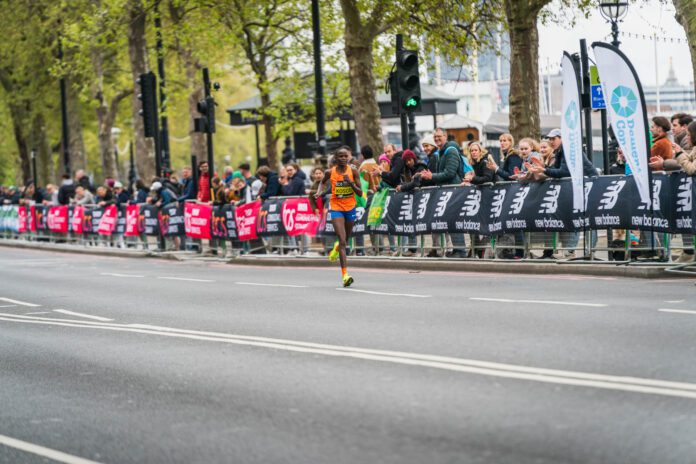
The London Marathon’s proposed two-day event for 2027 could mark one of the most significant structural shifts in modern distance running. After drawing more than 1.1 million applicants for the 2026 ballot, organizers are now exploring whether expanding the race across two days is not just a solution—but the future of the sport (BBC).
Rather than simply increasing capacity, the move raises a deeper question:
Has the traditional one-day marathon reached its limit?
Key Takeaways
- The London Marathon is considering a two-day format starting in 2027
- Participation could expand to 100,000 runners
- Elite men’s and women’s races may be split across separate days
- The model could influence other World Marathon Majors
- The biggest risk: losing the single-day magic of the event
Demand Is Forcing Change
The numbers are impossible to ignore.
With over a million applicants competing for a limited number of entries, the London Marathon ballot odds have become increasingly slim. What was once an exclusive achievement is now, for many runners, nearly unattainable.
According to The Guardian, the proposed expansion—sometimes referred to as the “Double London Marathon”—would allow up to 100,000 runners to participate across two days (The Guardian).
From an analytical standpoint, this isn’t just about access. It’s about scalability.
The current model:
- Maximizes prestige through scarcity
- Limits participation despite global demand
The proposed model:
- Expands access
- Unlocks significantly greater economic and charitable potential
Estimates suggest the new format could generate up to £130 million for charity, reinforcing the marathon’s role as more than just a race—it’s a fundraising platform (Greenwich Time).
A Smarter Way to Showcase Elite Racing?
One of the most compelling aspects of the two-day marathon format is how it could reshape elite competition.
According to ESPN, organizers are considering splitting elite men’s and women’s races across different days (ESPN).
This seemingly simple change could have major implications:
- Dedicated media coverage for each race
- Increased visibility for women’s elite racing
- Extended broadcast windows and storytelling opportunities
Currently, elite races often overlap, forcing audiences to divide attention. A two-day format could transform the marathon into a multi-day global viewing event—something closer to a championship experience than a single broadcast window.
The Risk: Does Bigger Mean Worse?
Not everyone is convinced this is progress.
The London Marathon is defined by a singular moment: one day where the city, the runners, and the global audience converge. Expanding the event across two days risks fragmenting that experience.
Concerns include:
- Extended road closures across London
- Increased strain on volunteers and infrastructure
- A diluted spectator atmosphere
- The potential loss of what makes the race feel “special”
There’s also a branding question. For decades, scarcity has elevated the prestige of the race. If entry becomes more accessible, does that prestige shift?
Could Other Majors Follow?
London may be the first to seriously explore a two-day marathon—but it won’t be the last if this works.
Other races already face similar pressure, including the New York City Marathon, Tokyo Marathon, and Berlin Marathon.
Each of these events struggles with:
- High demand
- Limited capacity
- Growing global interest
If London proves that a two-day format can scale successfully while maintaining quality, it could become a blueprint for the future.
That said, not every city can replicate London’s model. Course design, infrastructure, and political support all play a role—and not all majors have the same flexibility.
The Bigger Shift: Marathons as Global Platforms
What this proposal ultimately highlights is a broader evolution in the sport.
Marathons are no longer just races—they are platforms for:
- Mass participation
- Global media engagement
- Economic impact
- Charitable fundraising
A two-day London Marathon aligns perfectly with this shift. It transforms the event from a single-day race into a multi-day experience—closer to a festival of running than a traditional competition.
Is the Two-Day Marathon the Future?
It might not be universal—but it’s no longer unthinkable.
Some races will preserve their one-day tradition as part of their identity. Others, facing overwhelming demand and rising opportunity, may feel pressure to evolve.
If approved, the London Marathon 2027 two-day event won’t just be an expansion.
It will be a test.
And if it succeeds, it could quietly redefine what runners expect—not just from London, but from every major marathon in the world.