Official partner Koryo Tours announced that the North Korea Marathon, the 2027 Pyongyang International Marathon will not take place in its traditional April window and is instead expected to be held in October 2027, with October 3 listed as the most likely date pending final confirmation. No official reason was given for moving the race off its longstanding spring slot, a shift that comes after North Korean authorities abruptly canceled the April 2026 edition roughly a month before its scheduled April 5 date without public explanation.
For runners accustomed to predictable marathon calendars, that move is the starting point for a deeper look at how the event actually operates. Established in 1981 (and 1984 for women) to mark the April 15 birthday of North Korea’s late founder Kim Il-sung, the race spent decades tied to spring before pausing for five years starting in 2020 during pandemic border closures, returning in April 2025, and now shifting toward autumn 2027. Because core logistics sit under state and organizing committee decision-making rather than standard municipal permitting, details such as exact dates, tour packages, routes, time limits, package pricing, and entry caps are not confirmed until authorities finalize them.
How Foreigners Enter When Borders Are Largely Closed
Most major marathons begin with a time standard, lottery entry, or a standard registration portal. Getting to the start line in Pyongyang starts with whether your passport and guided package fall within narrow entry rules.
Since early 2020, North Korea has kept general international tourism largely closed, with limited exceptions such as Russian tour groups and a brief reopening of the Rason border zone in June 2025. Even when regular sightseeing is restricted, the marathon has served as a specialized exception through event visas processed via the DPRK Athletics Association and licensed travel partners like Koryo Tours.
- Guided itineraries only: Independent travel is not permitted, so international participants travel on structured tour packages (which in 2025 were limited to five-night packages), stay at designated hotels, and are accompanied by local guides outside the race itself.
- Passport and eligibility boundaries: Nationality rules restrict participation, including bans affecting U.S., South Korean, and Malaysian passports, while entry is structured around amateur runners rather than independent press or elite fields.
- Limited capacity and deposit priority: In April 2025, foreign participation was capped at roughly 200 runners amid tight travel logistics, far below the roughly 950 foreign runners who took part in 2019. Koryo Tours notes that runners who paid deposits for the canceled 2026 race will receive priority once October 2027 packages open, with overall capacity potentially shifting depending on how transport and broader tourism rules look by autumn 2027.
Inside Kim Il Sung Stadium and Pyongyang’s Streets
For runners who clear the entry requirements and line up for the full marathon, half marathon, 10K, or 5K, race morning centers on Kim Il Sung Stadium and Pyongyang’s wide city boulevards.
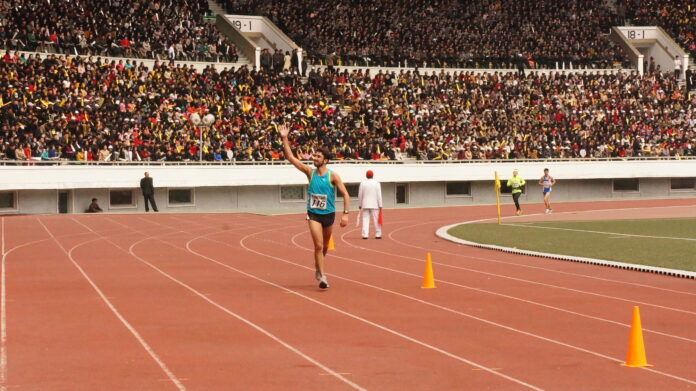
The race starts and finishes inside the stadium in front of tens of thousands of spectators before heading out onto broad streets closed to regular traffic, where crowds line the course to cheer and high-five runners. For athletes who have only seen Pyongyang on maps or broadcasts, moving through wide avenues lined with spectators creates a sharp contrast to the tightly scheduled sightseeing days around the event.
Camera Rules, Connectivity Limits, and the Strava Catch
Bringing a phone, camera, or GPS watch to the North Korea marathon comes with specific rules that set it apart from standard destination races.
- Photography and inspection rules: Runners can carry smartphones and compact cameras and shoot the event, but photographing military personnel, checkpoints, or active construction sites is prohibited, statues and portraits of Kim family leaders must be framed in full without cropping, and border checks on exit can inspect camera rolls and delete restricted images.
- Limited connectivity and content rules: Foreign SIM cards do not roam normally, public Wi-Fi is not available, and any paid hotel internet, when offered, is slow, costly, and filtered, leading most participants to post photos and recaps after leaving the country, where tour operators also caution against covert filming or mocking depictions that can put local guides at risk or prompt tighter restrictions.
- Syncing GPS data carefully: Even after departing, runners have to be mindful of how GPS files are uploaded, as Strava enforces a strict zero-tolerance policy tied to U.S. sanctions that can suspend or delete accounts uploading activities recorded in North Korea, leading many runners to record offline on a watch like Garmin and keep Strava disconnected before syncing.
What Runners Weigh Before Looking at October 2027
The shift to October 2027 also brings back the practical and personal trade-offs every runner evaluates before considering a trip. Several Western governments, including the United States, United Kingdom, Canada, and Australia, warn strongly against travel to North Korea and have limited or no consular presence on the ground if a medical emergency, injury, or legal issue occurs. Other runners weigh ethical questions around spending money on state-sanctioned travel or seeing a tightly curated slice of the country.
At the same time, the event continues to draw a distinct group of runners: athletes working toward running in every country, travelers curious about places few outsiders visit, and marathoners drawn to starting and finishing inside Kim Il Sung Stadium. With October 2027 now on the calendar, the question for prospective entrants is less about pacing splits and more about whether official dates, packages, and approvals hold steady.