

Running Shoe Foam Explained: EVA vs TPU vs PEBA (And Why It Matters)
FEATURED · ELITE & INDUSTRY NEWS
Letty Lundquist, Esq.
1/11/2026 · 5 min read
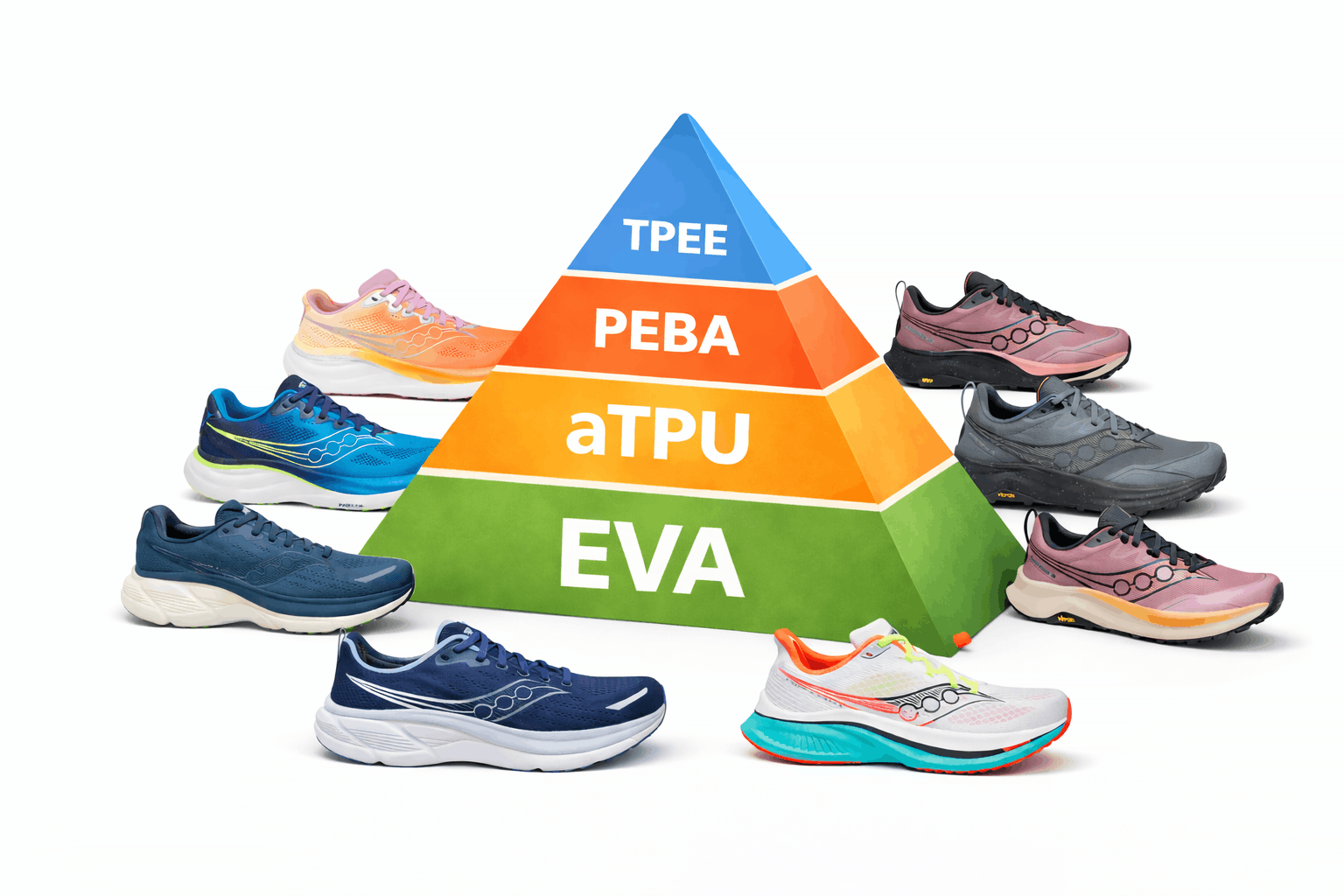
If you’ve ever wondered what running shoe foam actually does, you’re not alone. Terms like EVA, TPU, PEBA, and TPEE appear everywhere—from shoe boxes to online reviews—but most runners are left guessing how those materials actually affect comfort, durability, and performance.
Prefer to watch or listen? Click here to listen to the podcast. For our YouTube Video, click here.
Running shoe foam is the midsole material that determines how a shoe feels underfoot—how soft it is, how much energy it returns, and how long it lasts. Choosing the right foam can influence everything from daily training comfort to race-day efficiency.
To better understand how modern running shoe foams work, we spoke with Luca Ciccone, Director of Product Engineering at Saucony, who has spent more than 20 years developing midsoles for elite racers and everyday trainers alike. Rather than relying on lab jargon, Ciccone explains foam design using a simple analogy most runners can relate to: baking bread.
That perspective reveals why no single foam is “best,” and why understanding what’s inside your shoes matters just as much as mileage or pace.
The Bread Analogy That Explains Everything
“What if I told you making high-performance running shoe foam is very similar to making bread?” Ciccone asks. “Everybody understands the bread-making process.”
The analogy works because foam, like bread, starts with simple ingredients. Engineers begin with raw polymers—the “flour” of footwear. But just as no two loaves of bread are identical, no two foams behave the same. The outcome depends on how those ingredients are processed.
“The flour can be the same,” Ciccone explains, “but depending on the yeast, or how long you let the dough rise, you get completely different results.”
In footwear, that rising process is known as supercritical foaming—a technique that injects gas into heated material to create lighter, more resilient structures. Once the foam expands, it’s “baked” into the geometry of the midsole and then tested, both mechanically and on athletes.
“We build prototypes, put them on runners, and test them,” Ciccone says. “That’s how we know if we’ve made something that actually helps performance.”
The Foam Pyramid
To make sense of today’s materials, Ciccone describes what he calls a foam pyramid—a hierarchy that ranges from foundational foams to elite, race-day compounds. Each level serves a purpose, and none is inherently “bad.” The key is matching the foam to the job.
The most common running shoe foams include:
-
EVA (ethylene-vinyl acetate)
-
TPU and A-TPU
-
PEBA
-
TPEE
EVA: The Foundation
At the base of the pyramid sits EVA (ethylene-vinyl acetate), the most established material in running shoes. It’s been used since the late 1970s and remains a staple for daily trainers and stability shoes.
“The industry has the most experience with EVA,” Ciccone says. “There are thousands of formulations out there.”
Modern EVA is far more refined than its reputation suggests. It can be tuned for firmness, responsiveness, and stability, making it particularly effective in shoes with wider platforms and structured sidewalls. For many runners, EVA delivers predictable cushioning and reliable durability across hundreds of miles.
It may be the foundation—but it’s far from outdated.
TPU and A-TPU: Versatility and Longevity
Moving up the pyramid brings us to TPU (thermoplastic polyurethane), a material that balances softness, resilience, and durability. TPU foams tend to feel livelier than EVA while holding their structure longer, which makes them well-suited for daily trainers that need to handle both easy miles and faster efforts.
A key evolution within this category is particle-based TPU, often referred to as A-TPU (advanced TPU). Instead of a single molded slab, this foam is made from tiny expanded beads that are fused together.
“Each bead adds resilience,” Ciccone explains. “That balance is what makes it longer lasting and more responsive.”
A-TPU also allows for higher stack heights without excessive weight, making it ideal for long runs where protection and consistency matter most. The result is a foam that feels cushioned without going flat—a quality many runners notice most in the later miles.
PEBA: Speed and Efficiency
Near the top of the pyramid sits PEBA (polyether block amide), the foam that helped redefine modern racing shoes. Technically a type of high-performance nylon, PEBA behaves like an elastomer—stretching and snapping back with remarkable efficiency.
“It offers ultra-lightweight performance and high energy return,” Ciccone says. “That snap and responsiveness is why athletes trust it.”
Initially reserved for race-day shoes, PEBA has gradually made its way into training models as manufacturing processes improved. That shift has allowed runners to experience race-like responsiveness more often, rather than saving it exclusively for competition.
For many athletes, PEBA shines in workouts, tempos, and faster long runs—any scenario where efficiency matters as much as cushioning.
TPEE: The Pinnacle
At the very top of the pyramid sits TPEE (thermoplastic polyester elastomer)—a material reserved for the most advanced running shoe foams.
Ciccone’s comparison is simple and revealing: “It’s the same material used on the top fabric of trampolines.”
That’s not hyperbole. TPEE is used industrially as a non-metallic spring. When foamed and shaped into a midsole, it delivers a uniquely energetic ride—one that becomes more apparent the harder you push.
“A trampoline isn’t meant to be walked on,” Ciccone explains. “It’s meant to be jumped on. The same thing happens with this foam.”
TPEE tends to feel best at faster paces, where force and loading allow the material to fully rebound. For runners who enjoy feeling propelled forward, it represents the current ceiling of foam performance.
Plates: Working With the Foam
Foam rarely works alone. Plates—made from carbon fiber or nylon—are often embedded within midsoles to guide motion and amplify energy return.
Early designs focused primarily on stiffness, but modern plates are far more nuanced. Today’s goal is longitudinal stiffness for propulsion, without excessive rigidity that interferes with natural movement.
Different shoes call for different solutions. Carbon plates dominate racing, while nylon plates are often used in speed-oriented trainers to add snap without overwhelming the foam. Some shoes skip plates entirely, relying instead on geometry and material properties.
Durability, Outsoles, and Trade-Offs
If your outsole rubber has worn through to exposed foam, it’s time for a new pair. That said, not all visible foam is a problem. Strategic exposure can allow the midsole to compress and articulate more naturally.
Covering everything in rubber would improve durability—but at the cost of weight, flexibility, and feel. Like foam selection, outsole design is a series of trade-offs.
Why Foam Matters More Than Ever
After years of rising prices, shoe costs are beginning to stabilize. As brands gain experience with advanced materials, production scales up and efficiency improves. Better foams also tend to last longer, offering more value over time.
Rather than chasing novelty, Ciccone sees the future as one of refinement.
“We’re not reinventing the wheel every year,” he says. “We’re making it better.”
Practical Takeaways for Runners
The most important advice isn’t about materials at all: follow a smart training plan and avoid overtraining.
From there, build a shoe rotation. Different foams stress the body in different ways, and rotating between them can help you adapt while reducing overuse risk.
-
EVA for structure
-
TPU for versatility
-
A-TPU for long runs
-
PEBA for speed
-
TPEE for maximum energy
Final Thoughts
Understanding foam isn’t about chasing hype—it’s about choosing the right tool for the job. Engineers mix ingredients, let them rise, bake them into shape, and test relentlessly. When it works, runners feel the difference.
The bread analogy holds. You don’t need to know every ingredient to enjoy a great loaf—but understanding the process helps you appreciate why some shoes feel just right.
And once you know what’s underfoot, choosing your next pair becomes a lot less mysterious.