
To the global running community, the Boston Marathon is the ultimate destination—a historic race that demands intense dedication just to secure a spot at the starting line. But for Camila Canavese, a mother of two and a fixture in the Boston running scene, the race wasn’t just a world major. It was a landscape of trauma that took a decade, and an unimaginable loss, to overcome.
Three Blocks Away: The Trauma of 2013
Camila has lived in Boston for eighteen years, but her roots in endurance sports began as a young swimmer and triathlete in Brazil. On April 15, 2013, she was just three blocks away from the finish line inside a client’s building when the bombs went off.
“I heard the noise and I thought it was fireworks,” Camila remembers. “But then I turned on the TV and saw the bomb explosion.”
The hours that followed were a blur of gridlock and sheer panic as she spent two hours stuck in traffic trying to reach her kids. Living in Watertown—the ultimate epicenter of the massive law enforcement lockdown—the psychological toll was severe. For two years, Camila suffered from paralyzing panic attacks just driving near Boylston Street, eventually forcing her to give up clients. For ten full years, she refused to look at the finish line.
Walking Back to Boylston Street
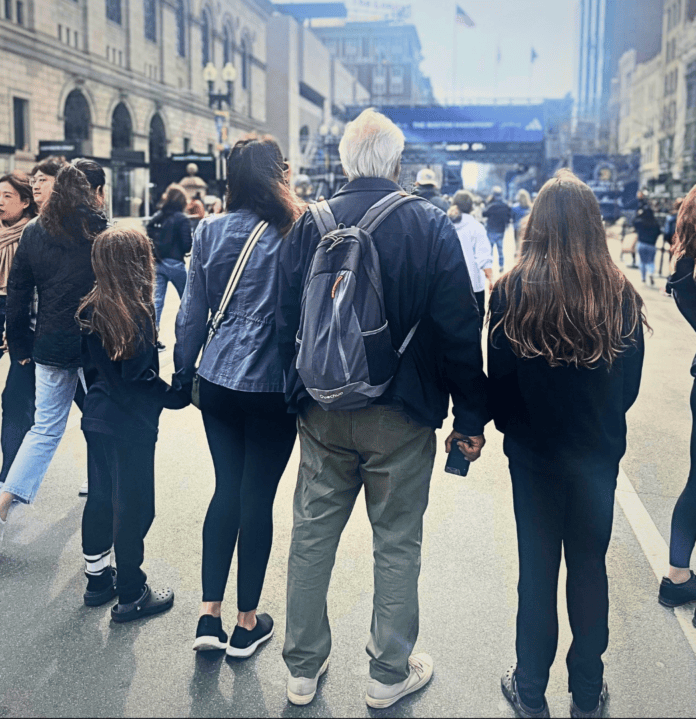
It took her father—her biggest athletic champion growing up—to pull her back into the light. In 2023, he visited from Brazil for the marathon weekend and held her hand.
“He was like, ‘No, we go together. We go to the finish line… you have to go,'” Camila says. “I told him, ‘If you go with me, I’ll go. I’ll feel safe.'”
Standing at the corner where the runners turn onto Boylston Street, the heavy grip of trauma finally broke. Swept up in the defiance of the “Boston Strong” movement, Camila promised her dad she would return to training. He immediately found her a coach, and became her weekly sounding board, calling her every single Sunday to check in on her long runs.
By 2024, Camila had poured her passion into serving as an indispensable guide and finish-line cheerleader for hundreds of Brazilian marathoners traveling to Boston, a group that fondly refers to Boston as the “Queen Marathon.”
Running Through the Fog of Grief
But just as her momentum was building, tragedy struck. In May 2025, exactly two weeks after the marathon, Camila’s father suffered a sudden, fatal heart attack.
The loss was catastrophic. Because her return to running was fundamentally intertwined with her father, her immediate instinct was to walk away from the sport completely.
“I was going to give up,” Camila admits. “You lose your dad and you think, ‘What is my position now? I’m not a daughter anymore.’ It’s a weird feeling.”
Through the support of a dedicated friend and the watchful eyes of her two teenage boys, Camila forced herself back out onto the pavement. Her energy was shattered, but she ran anyway, completing half marathons in October and November to process her grief step by step.
When I asked how she managed to lace up her shoes during the darkest months of her life, she dropped a truth that gets to the very core of why we run:
“If I wait to heal from this pain until I go back to running, that will never happen. Do it. The process is gonna come.”
The Dynamic ‘Why’
Today, Camila is eyeing a future full marathon training block, drawing deep inspiration from the global community she hosts on the streets of Boston.
“If it’s only going to be about me, I don’t want to do it,” Camila notes. “My why is to inspire people… You’re going to heal whatever you need to heal in the process of running.”
Marathoners are a unique breed. But as Camila reminds us, almost every runner grinding through the miles is running from something or running toward someone. You don’t have to be completely healed to step up to your next starting line. You just have to trust that the simple act of putting one foot in front of the other will eventually carry you through.