
Carbon-plated running shoes changed the sport.
But here’s the real question:
Do everyday runners actually need to spend $250–$300 to access that technology?
When I sat down with Pooja Bansal, founder of Swift Running, we didn’t talk about chasing elite podiums. We talked about something much more relatable:
Moms logging miles before work.
Recreational runners managing knee pain.
Parents trying to afford gear for both themselves and their kids.
And that’s where this story gets interesting.
From Recreational Runner to Footwear Founder
Pooja didn’t grow up as a competitive athlete. She found running in her late 20s and early 30s — after becoming a mother.
Like many runners in our Marathon Journal community, running became her reset button.
“This was my ‘me time.’ I wanted to take care of my body and bring it back to where I was.”
But as mileage increased, so did something familiar to many runners:
Knee discomfort.
A visit to a specialty running store introduced her to carbon-plated shoes — and a harsh pricing reality. Many plated daily trainers now sit in the $200–$300 range.
And then comes the bigger problem:
One shoe isn’t enough.
You need:
- A daily trainer
- A long-run shoe
- A tempo shoe
- A recovery shoe
That can quickly turn into a $700+ rotation.
For the average runner, that’s a barrier.
The Problem With “Running on Clouds”
One of the more compelling philosophies behind Swift Running is their stance on structure.
The industry trend has leaned heavily toward max-cushion midsoles — what Pooja calls “running on clouds.”
But soft doesn’t always mean stable.
Swift Running builds plated trainers designed to provide:
- Midfoot structure
- Postural support
- Controlled energy return
Instead of building race-day-only super shoes, they integrate plated systems into everyday trainers — at a significantly lower price point than many legacy brands.
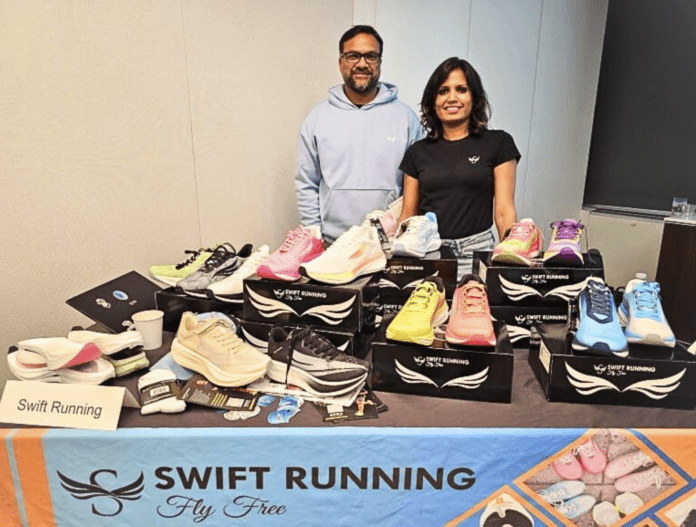
Swift Running Shoe Lineup: A Full Training Rotation
Launched in November 2024 after nearly three years of prototyping, Swift Running entered the market with a bold idea:
Build a full shoe rotation under one brand — at accessible pricing.
Here’s how their lineup breaks down:
Horus – Plated Daily Trainer
- Hybrid plate at the arch
- Designed for 5K–10K training
- Stable enough for gym sessions
- Balanced cushioning with structure
Best for: Runners looking for a plated daily trainer without super-shoe instability.
Apus – Long Distance Trainer
- Lightweight ETPU midsole
- Breathable mesh upper
- Hybrid plate for longer efforts
- Durable outsole for light mixed terrain
Best for: Long-run comfort with added structural support.
Equus – Lightweight Tempo Trainer
- Pure carbon plate at the arch
- Under 200 grams
- Designed for track sessions and speed work
- Durable CPU outsole (up to ~600 miles)
We tested the Equus for faster workouts, and it delivers responsiveness without the overly aggressive rocker found in many racing super shoes. See our review here.
Best for: Speed sessions and tempo efforts.
Cellar – Recovery Trainer
- Additional cushioning layer
- Impact-resistant design
- Popular with healthcare professionals and those on their feet all day
Best for: Easy miles and recovery days.
Affordable Carbon Plated Running Shoes: How Is Pricing Lower?
Swift Running operates primarily as a direct-to-consumer running shoe brand.
That eliminates large retail markups and celebrity endorsement costs.
According to Pooja, pricing was intentional from day one:
“We could price these at $200–$250. But that defeats the purpose. We want everyday runners to afford performance.”
Instead of exclusivity, they’re targeting accessibility.
In their first year, Swift Running reports approximately 15% repeat customers — a strong indicator for a young footwear brand.
Carbon Plate Running Shoes for Everyday Runners — Do You Need Them?
This is where the broader conversation matters.
Carbon plates aren’t just about speed.
They can:
- Improve midfoot stability
- Assist with energy return
- Reduce muscular fatigue over longer efforts
But not every runner needs an aggressive race-day super shoe.
Swift Running’s approach introduces a progression model:
- Hybrid plate trainers for daily use
- Pure carbon trainers for faster work
- Full carbon race-day model (currently in development)
That education-first approach is something the industry often overlooks.
What’s Next for Swift Running in 2026?
The brand is targeting 3x growth this year and expanding into:
- Performance apparel (tanks, shorts, sports bras)
- Trail trainers (in testing)
- A full carbon race-day shoe
Ambassador programs are expanding beyond the DMV region, with grassroots marketing focused on local running clubs and high school coaches — not just major marathons.
Why Marathon Journal Is Watching This Space
At Marathon Journal, we evaluate gear through one lens:
Does it help the everyday runner train smarter, stay healthier, and perform better?
The majority of runners aren’t professional athletes.
They’re balancing life, work, family — and still showing up for their miles.
If affordable carbon plated running shoes become more accessible, that’s worth paying attention to.
Swift Running is still young. But the philosophy — performance without exclusivity — is one we believe deserves space in the conversation.
Want More Honest Gear Reviews?
We test shoes, interview founders, and break down running industry trends so you don’t waste money on hype.
👉 Subscribe to MarathonJournal.com for:
- Unbiased shoe reviews
- Marathon training insights
- Industry interviews
- Budget-friendly performance gear recommendations
Because performance shouldn’t require a premium marketing budget.