

As the Tokyo Marathon 2027 approaches its milestone 20th anniversary, the Tokyo Marathon Foundation is signaling that the next era of the race won’t just be about celebrating tradition—it will be about setting aggressive new industry standards.
In a massive announcement, organizers unveiled a sweeping transformation of the event that impacts everything from elite competition to the global environmental footprint of mass participation sports.
The $170,000 Headline
Perhaps the most eye-catching move is a major financial investment in the elite field. Tokyo is effectively doubling its top prize, now offering $170,000 to the men’s and women’s open champions. Historically, Tokyo’s top prize sat at 11,000,000 JPY (roughly $75,000 to $80,000 USD depending on exchange rates). This massive bump officially vault-poles Tokyo past Boston ($150,000) to claim the largest standard champion’s check in the Abbott World Marathon Majors (AbbottWMM) series.
“The world’s top athletes will be competing in a thrilling race as they vie for the $170,000 champion’s prize, the largest ever in the Abbott World Marathon Majors (AbbottWMM),” the Foundation noted in its official release.
By pushing the purse to this new benchmark, Tokyo is making a clear play to attract world-record-pace talent to its notoriously flat, fast course. Here is how the baseline elite champion payouts stack up across the Majors:
| Abbott World Marathon Major | Baseline Elite Champion Payout (1st Place) |
| Tokyo | $170,000 |
| Boston | $150,000 |
| New York City | $100,000 |
| Chicago | $100,000 |
| London | $55,000 |
| Berlin | $50,000 |
Note: These figures represent advertised baseline prize structures; top-tier athletes often negotiate additional private appearance fees.
Expanding the Start Line and Enhancing Inclusivity
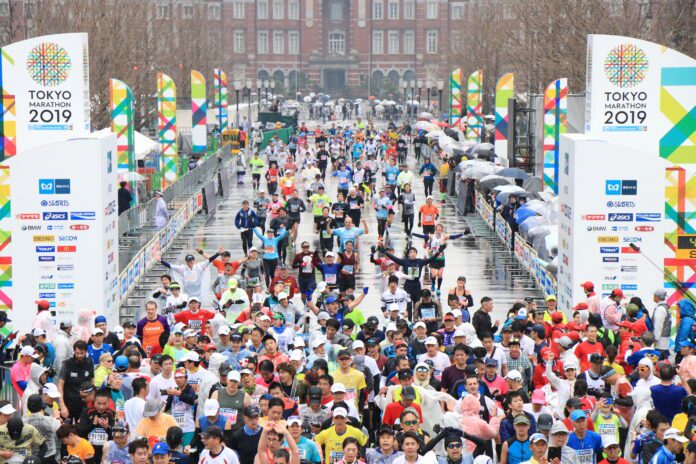
For the field toeing the line in the Japanese capital, the race will look and feel much larger. The Foundation announced it is increasing total runner capacity from 39,000 to a record 40,000 participants, making it Japan’s largest marathon.
To optimize the course flow for a field of this scale, organizers are making a strategic pivot in their programming. The traditional 10.7km short-course race is being retired, with those participant slots being fully absorbed into the marathon field.
In its place, Tokyo is launching a premier Elite Para-Athlete Division and expanding its mass-participation disability entry categories. This includes the formal debut of the Duo Team Division—where a runner pushes a teammate in a specialized racing buggy—following a highly successful trial run.
The 24-Month Sustainability Countdown
While the prize money and field expansion will dominate athletic headlines, the most significant long-term news lies in the race’s commitment to the planet.
Tokyo’s post-event carbon audit, conducted in collaboration with sustainability partner ASUENE Inc., identified a final footprint of 26,628 t-CO2 (metric tons of carbon dioxide equivalents). While this final number came in $2.3 higher than initial pre-race projections, the increase was a result of strict transparency: organizers utilized highly granular post-race data to precisely track stakeholder and participant travel, separating international flight metrics from domestic ones.
Rather than hiding from the data, the Foundation is using it as a starting block. Alongside the 20th-anniversary upgrades, Tokyo has committed to a definitive emissions reduction roadmap with a singular target: achieving complete carbon neutrality by the Tokyo Marathon.
Carbon neutrality means hitting a perfect balance where you stop adding extra pollution to the planet. For a massive event like the Tokyo Marathon, it’s a net-zero math equation: you drastically cut down the pollution you can control—like banning single-use plastics, using electric lead cars, and running the race expo on solar energy—and then you balance out the rest, like the inescapable pollution from thousands of runners flying in on airplanes, by investing in planet-saving projects like planting forests or funding clean energy. Think of it like a strict “leave no trace” camping rule; you clean up every bit of your own mess until it’s like you were never even there.
The Marathon Journal Take
Wiping out a 26,000-ton carbon footprint—the equivalent of driving an average passenger car over 68 million miles—in a tight timeframe is an incredibly ambitious logistics challenge. Because the bulk of any major marathon’s environmental impact stems from international travel, Tokyo’s roadmap will force deep innovation in green event production, local renewable energy sourcing, and runner mitigation strategies.
By drawing a hard line in the sand, Tokyo is challenging Boston, London, Berlin, Chicago, and New York to match their data transparency—and their timeline. The running world will be watching closely to see if the logistics can match the grand scale of the ambition.