
Filming a marathon effort, recording a tempo workout, or capturing a fast track session has always meant accepting a terrible compromise. Carrying a smartphone or holding a traditional action camera on a floating handle wrecks your upper-body mechanics. Your shoulders tense up, your stride asymmetry creeps in, and your focus shifts away from running economy toward framing a shot.
Historically, choosing an ultra-lightweight wearable camera meant settling for restricted frame rates, mud-like low-light footage, internal memory ceilings, and a battery that routinely expired before you hit the 10K mark.
Enter the Insta360 GO Ultra.
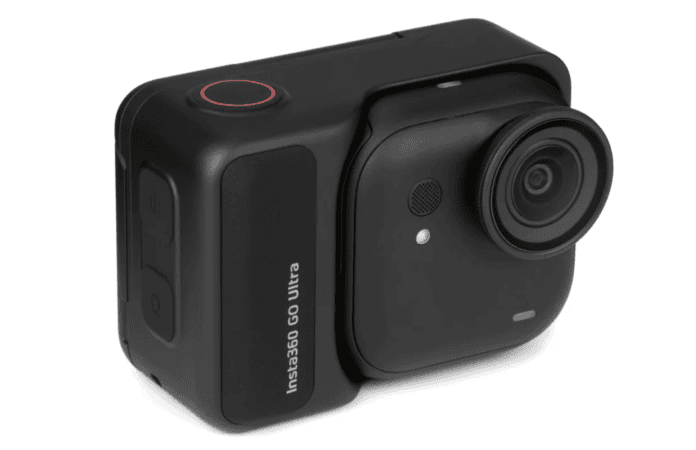
Priced at $449, this micro-wearable aims to erase the line between lightweight convenience and flagship video quality. By fitting a massive 1/1.28-inch sensor, 4K recording at 60 frames per second, a standalone microSD slot, and expanded battery life into a tiny 53-gram chassis, it promises distraction-free recording for serious runners.
Here is our in-depth look at how the GO Ultra stacks up for endurance athletes who want zero friction on race day.
1. The On-Body Experience: Weight & Mounting Ecosystem
The core advantage of the GO series lies in its two-piece modular architecture. By pressing a side-release latch on the main Action Pod housing, you pop out the micro-camera and leave the touchscreen control unit behind.
- The 53-Gram Footprint: While the camera unit gains roughly 14 grams over the older GO 3S, 53 grams (1.86 oz) remains virtually weightless when pinned or clipped to lightweight technical apparel.
- The Hat Brim Clip: Clipping the camera onto the bill of a standard running cap offers true eye-line perspective. Because the mass is so small, it avoids the annoying forward pull, vertical bounce, and forehead pressure common with heavier action cameras.
- The Magnetic Shirt Pendant: Worn underneath a singlet or split-short waistband, the magnetic pendant locks the unit flush against your chest. An integrated 15-degree angle adjustment plate allows you to dial in horizon leveling without wearing tight, restrictive chest straps across your ribs.
Runner’s Note: The standalone camera body carries an IPX8 waterproof rating down to 33 feet (10 meters). However, the Action Pod shell is only IPX4 splash-resistant. If you are running through heavy rain, keep the core camera on your apparel and leave the pod safely stored in a dry pocket.
2. Sensor Architecture & Motion Performance
Insta360 upgraded the internal optical engine precisely where runners need it most.
| Spec Feature | Insta360 GO Ultra | Previous Generation (GO 3S) | Runner Benefit |
| Sensor Size | 1/1.28-inch BSI CMOS | 1/2.3-inch Sensor | 221% larger light gathering area for cleaner shadow retention |
| Max Resolution & Frame Rate | 4K at 60 FPS | 4K at 30 FPS | Eliminates high-speed motion blur; enables 2x slow-mo stride analysis |
| Low-Light Processing | 5nm AI Chip (PureVideo) | Standard Processing | Reduces visual noise during early morning pre-race warmups |
| Memory Capacity | Removable MicroSD (up to 2TB) | Fixed Internal (32GB–128GB) | Allows quick card swapping on multi-day training trips |
Moving from 30fps to 60fps in native 4K resolution changes everything for high-cadence sports content. Fast-moving terrain, passing runners, and arm swings render smoothly without rhythmic motion stutter, giving creators high-quality footage for post-production editing.
3. Battery Management: Solving the 10K Ceiling
Battery longevity is usually where micro-wearable cameras fail during long distance events. The GO Ultra introduces substantial runtime improvements:
- Standalone Camera: Up to 70 minutes of continuous recording in 1080p, or approximately 60 minutes in full 4K at 60fps.
- Docked System Runtimes: Paired with the battery inside the Action Pod, total system runtime extends to roughly 170 to 200 minutes.
- Fast-Charging Protocol: Placing a depleted camera inside the Action Pod recharges the battery from 0 to 80% in 12 minutes.
For half-marathoners and 10K competitors, a 60-to-70-minute standalone window removes mid-race anxiety. You can snap the camera onto your apparel at the start line, trigger recording with a single tap, and execute your pacing strategy without managing power levels mid-effort.
4. Telemetry Overlays & Native Audio Integration
Modern sports vlogging relies on context, and the GO Ultra’s software integration brings viewers directly into your effort.
[ Garmin / Apple Watch / Strava / Coros ]
                  │
                  ▼ (Bluetooth App Sync)
     ┌────────────────────────┐
     │   Insta360 Mobile App  │ ──► Overlays: Pace, HR, Cadence, Elevation
     └────────────────────────┘
Through the mobile companion app, you can pair telemetry data recorded by your Garmin, Apple Watch, Strava, or Coros account. During file export, you can layer real-time metric overlays—such as live heart rate, pace per mile, elevation change, and stride cadence—directly onto your video footage.
For audio capture, dual built-in microphones utilize wind-reduction algorithms to protect voice clarity when running into head winds. Additionally, native Bluetooth support allows you to sync wireless microphones or wireless earbuds directly to the camera for crisp, continuous voiceover commentary while on the move.
The Verdict
At $449 USD, the Insta360 GO Ultra steps directly into flagship price territory, competing alongside full-sized traditional action cameras.
If your primary need is extreme physical durability or continuous multi-hour battery life without stopping to dock, a standard action camera retains a slight edge. However, for distance runners and creators seeking a distraction-free, low-profile setup that captures pristine 4K60 footage without disrupting natural biomechanics, the GO Ultra sets an impressive benchmark for race-day coverage.