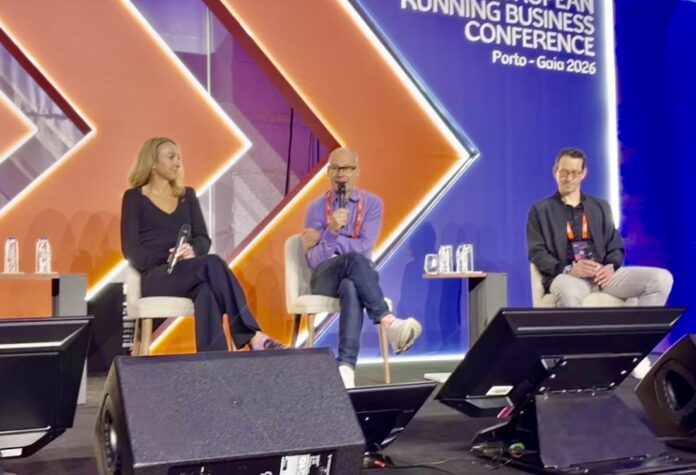
At the European Running Business Conference in Porto-Gaia, Paula Radcliffe, Hugh Brasher and Mark Milde discussed Women’s Running: why welcoming more women means addressing safety, pregnancy, periods and the pressures of training around family life.
A woman planning an early-morning run may have to think about more than pace and distance. Is the route safe in the dark? Can training fit around childcare? What happens to a race entry if she becomes pregnant? Will the event have the products and facilities she needs?
At the European Running Business Conference 2026, those questions came to the fore in a panel titled “From World Records to World Impact: Getting Women and Youth Running.” Held in Porto-Gaia on November 6–7, the conference discussion was moderated by Guy Horne, managing director at H&A Media. The panel featured European Athletics President Dobromir Karamarinov, London Marathon Events CEO Hugh Brasher, BMW Berlin Marathon Race Director Mark Milde and Paula Radcliffe, ambassador for the conference and the EDP Porto Marathon 2026.
The panel’s most pointed argument was that welcoming women into running requires more than inviting them to sign up. Organizers must consider the real circumstances that shape whether women can train, race and stay involved.
“You have to start thinking about equity”
Hugh Brasher challenged the idea that treating all runners identically is necessarily fair.
“Men do not get pregnant,” he said. “Men do not have menstrual cycle.”
Brasher also spoke about safety, describing how the clocks changing in the UK affected his wife’s usual early-morning run. She normally went out at six, but when it was darker, she delayed her run and avoided a route she would otherwise use. The route itself had not changed. Her ability to use it comfortably had.
For many women, decisions about when and where to run can involve weighing daylight, isolation and personal safety. That affects everyday training, not only race day. Brasher urged organizers to recognize these differences and move from a simple idea of equality to equity, understanding that runners can face different barriers and may need different support.
“As organisers, we have to understand,” he said. “I’ve got to listen.” He added that organizers should “start listening to women” and “act on what they say.”
That means taking feedback seriously, rather than assuming that a route, start time or event policy works equally well for everyone. It also means recognizing the role men can play. Brasher asked how men can call out inappropriate behaviour and act as allies, making clear that women’s safety is not only a concern for women to manage.
The details that can make women feel welcome
Mark Milde described practical measures intended to make participation more workable. These included allowing a runner who becomes pregnant before race day to defer her entry, making menstrual products available and providing rooms where women can go with their babies.
They may sound like small provisions, but they carry a larger message: the event has thought about women’s needs before they arrive. A pregnancy deferral can mean a runner does not have to choose between racing and forfeiting her entry. A room for parents and babies can make participation feel possible for someone who might otherwise stay home. Having menstrual products on site means a runner is not left to hope that an essential item will be available.
Milde said organizers want to provide a platform where female runners can come to races and feel welcome. He also described a rise in women’s participation at the Berlin Half Marathon. In the 18-to-25 age group, he said, almost 60 percent of participants are women. For those aged 25 to 30, the figure is around 55 percent, before the numbers become more balanced among older groups.
Milde said a positive experience at the half-marathon distance could encourage some runners to take on a full marathon later. The important point is not that every woman should move up in distance. It is that the sport should make room for different goals and stages of life, instead of treating the marathon as the only measure of commitment.
Training time, childcare and the marathon decision
Radcliffe spoke about the demands women can face when fitting training around family responsibilities. “Those restrictions, perhaps on women coming into the sport, like childcare, like taking the time out to have the children, like the guilt feeling,” she said, can affect whether a woman feels able to commit to marathon training rather than a half marathon.
Her point offered a more personal dimension to a discussion otherwise focused on event policies. A marathon training plan takes time, week after week. For a runner balancing work and family, the decision is not simply whether she is fit enough or motivated enough. It may also depend on whether the training load can fit into the rest of her life.
That makes the quality of the experience at every distance important. A half marathon can be a destination in its own right, or it can be a step toward a longer race. Neither choice should be treated as more legitimate than the other.
The panel’s practical examples suggest that organizers can help by providing flexibility when life circumstances change and by creating event environments that account for women’s needs. These actions do not remove every obstacle, but they can make participation less dependent on a runner having exceptional time, support or resources.
Visibility inspires, but experience keeps runners coming back
Radcliffe reflected on the influence of women who came before her, saying that role models had helped show the way for later generations. Seeing women running and competing at the highest level can help others imagine themselves doing the same.
Brasher recalled the effect of Radcliffe’s 2003 London Marathon performance. He said that the day after her run, women began coming into the retail store where he worked in such numbers that the brands struggled to keep up with demand for running shoes. It was an example of how a high-profile performance can inspire participation well beyond the elite field.
But visibility alone is not enough. Brasher said people need to see “different cultures running,” “different women running” and “different shapes running.” Representation can help women picture themselves as runners. Event policies and practical support show whether the sport is prepared to welcome them.
That distinction matters. A photograph of women on a race website may communicate inclusion, but a clear pregnancy deferral policy or a safe, supportive event experience can make inclusion tangible. Promotion can invite women in. The experience determines whether they feel they belong.
A question for every race organizer
The panel did not offer one solution that will fit every event. Its message was more direct: organizers should ask women what makes participation difficult, listen carefully and make changes in response.
That starts with practical questions. Are entry policies flexible when a runner becomes pregnant? Are menstrual products available? Are parents with babies considered in event planning? Do organizers understand how safety affects women’s training choices? Are women visible across different ages, communities and body types, not just in elite coverage?
For runners, clubs can also provide an alternative to training alone. Radcliffe described the camaraderie and shared spirit of running as powerful parts of the sport’s appeal. Group running may help women who want company or a greater sense of safety, while also providing motivation and connection.
The panel’s title promised a move “from world records to world impact.” On women’s participation, that impact can be found in decisions that are practical and measurable: a race entry that can be deferred, a room for a parent and baby, menstrual products available when needed, or an organizer willing to change a policy after listening to women.
Women do not need to be convinced they are capable of running. The sport needs to show, through its choices, that it understands what can stand in their way and is willing to make room for them.