

Every major race morning, the routine is identical. We stand inside our starting corrals, checking our watches, adjusting our super-shoes, and locking in our mental pacing strategies. Then, the announcer calls out the elite wheelchair marathon division, the gates open, and a pack of athletes rockets away into the morning fog.
For many runners, that’s where the connection ends. Because the wheelchair division starts ahead of the foot race, it is easy to view them as an entirely separate entity—a prelude to the running waves rather than the high-stakes, aerodynamic chess match that it actually is.
The truth is, we aren’t just sharing the road with a different division; we are sharing it with athletes who are rewriting the absolute limits of human-powered velocity on asphalt.
To get a true look at the engineering and mechanics behind this side of the sport, my husband Ryan and I took our family straight to the source. During our summer travels, we visited the world-renowned Paralympic Training Center in Nottwil, Switzerland, to spend the day with Marcel Hug, the “Swiss Silver Bullet.” Hug is a multi-time world record holder, the reigning king of the Abbott World Marathon Majors, and one of the most dominant endurance forces on the planet. (To hear the full, unfiltered conversation from our visit, check out Episode 319 of the Marathon Running Podcast!)
If you want to expand your endurance vocabulary beyond stride lengths and foam densities, it’s time to look at the very same 26.2 miles we tackle from a perspective driven by pure physics, tech, and speed.
The Legend of the Silver Bullet
For over twenty years, fans and competitors have picked Marcel Hug out of the racing field by a singular trademark: his gleaming silver helmet.
The story behind the gear dates back to Christmas in 2001 or 2002. Hug’s junior coach had seen a striking silver helmet at the Sydney 2000 Paralympics and tracked one down as a gift for his young athlete. His family and friends loved it because the bright, reflective finish made him instantly recognizable in the middle of a chaotic, tight racing pack.
The moniker “Swiss Silver Bullet” stuck permanently during a subsequent World Championship event in New Zealand. Yet, despite a career that has yielded a massive collection of gold medals, Hug has intentionally kept the silver helmet. For him, a gold helmet carries an unnecessary weight of expectation and ego. It is a choice that reflects the quiet humility he displays off the course—a stark contrast to the aggressive, calculated machine he becomes the second he locks into the racing chassis.
1. The Physics of Downhill Speed
When a runner hits a massive descent on a marathon course, the strategy centers on letting gravity work while managing quad fatigue. When a wheelchair athlete hits a major drop, the scale of speed shifts entirely.
Down the famous, sweeping descents of the Boston Marathon, Hug reaches peak speeds of 78 kilometers per hour—just under 48.5 miles per hour. He is navigating public roads at highway velocities, hovering mere inches off the asphalt with nothing but a racing suit and a helmet.
Because major metropolitan marathons cannot close public streets for high-speed practice runs prior to race morning, athletes often hit these descents at full velocity without a trial run. It requires absolute, flawless concentration to read the road surface half a second ahead, spotting potholes, stray water bottles, or sunken drainage grates at a speed where a single mechanical failure or clip means a high-speed crash.
2. The Direct Transfer of Power
One of the most common technical misconceptions among able-bodied spectators is confusing a racing wheelchair with a hand cycle. Hand cycles operate like bicycles for the upper body, utilizing hand pedals, chains, and a complex system of gears to manage resistance.
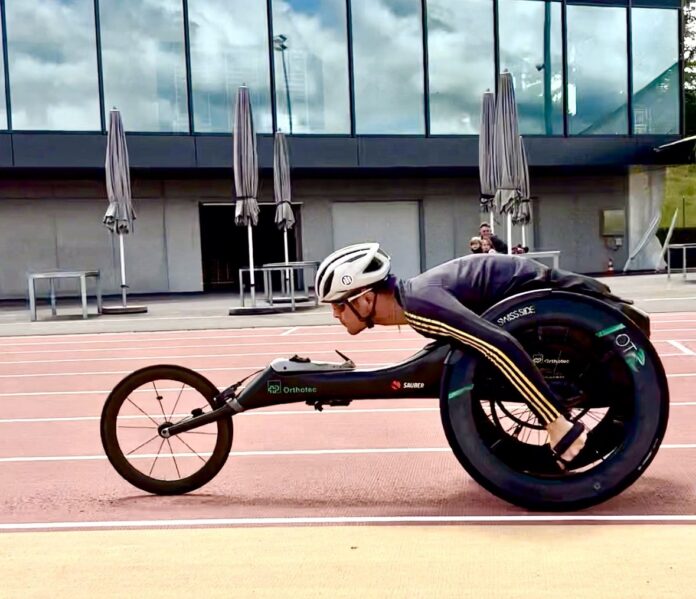
A racing wheelchair features no gears, no chains, and no mechanical shortcuts. The chair is propelled via a fixed, rubberized metal ring attached directly to the outside of the rear wheel, known as the push rim. Hug doesn’t grip or roll the wheel; he wears ultra-hard, custom 3D-printed gloves and literally strikes the rims at a furious, rhythmic cadence. It is a direct, violent transfer of raw upper-body power into spinning metal.
When the course tilts upward, there is no shifting into a lighter gear to preserve the muscles. On a steep incline, the only option is to increase the force of the strike using the lats, shoulders, and chest. Because the human body relies entirely on the smaller muscle groups of the upper body for this traction, steep hills are the one place on a course where elite runners can match or outpace the chairs. But once they crest the peak, the physics shift right back.
3. Wearing the Chassis
As runners, we look for footwear that offers the right blend of cushioning, toe-box width, and minor footbed adjustments. In elite wheelchair racing, the interface between the athlete and the equipment is absolute.
Hug’s racing chair centers around a custom-molded carbon fiber chassis known as a “bucket.” The seat is laser-scanned and engineered specifically to his body’s exact skeletal structure. He doesn’t sit in the chair; he is tightly wedged, buckled, and ratcheted into a deep, aggressive forward fold designed to minimize aerodynamic drag.
If there is even a single millimeter of shifting or “play” inside that bucket, the kinetic energy generated by his arms is absorbed by the frame instead of transferring cleanly to the wheels. The connection between the human engine and the carbon chassis must be completely rigid. Hug notes that the position is so intensely compact and restrictive that he can tolerate being strapped into it for only about two hours before the physical strain becomes agonizing.
4. Aerodynamic Strategy and the Peloton
Because wheelchair fields maintain an average flat speed of 18 to 20 miles per hour, the fluid dynamics of air resistance completely dictate the tactical narrative of the race.
Just like in professional cycling, sitting directly in the slipstream of a leading racer cuts wind resistance significantly, yielding an immediate 10% to 20% savings in physical energy. Because of this, the front of a wheelchair marathon behaves exactly like a high-speed cycling peloton.
Athletes form tight, synchronized pacelines, hovering centimeters from each other’s rear wheels at high speeds. They play a constant tactical chess game—trading the lead to share the physical burden of breaking the wind, positioning defensively to block passing lanes, and drafting to save energy before unleashing a final, furious sprint for the finish line.
5. Innovation in the Wind Tunnel
The technology driving wheelchair racing has evolved alongside the materials science that revolutionized running’s super-shoe era. Marcel has spent years working directly with Swiss engineers to test the mechanical limits of his equipment.
For decades, conventional wisdom dictated that solid disc wheels were the most aerodynamic choice for blocking wind drag. However, when engineers put Hug in a wind tunnel to analyze the airflow around his specific racing chassis, the data revealed a surprise: because a wheelchair racer sits directly between two massive rear wheels rather than over a single central wheel like a cyclist, open-spoke wheels actually improved aerodynamic efficiency by altering how the air moved through the center of the frame.
Furthermore, these rigid carbon rigs feature zero built-in suspension or shock absorption, as any mechanical padding would sap precious kinetic energy from the athlete’s push. When Hug raced over the brutal, bone-rattling cobblestones of the Paris marathon course, his only option for stability was to drop his tire pressure significantly—acting as a manual cushion and intentionally trading away top-end speed just to keep the chair steady on the stones.
Bridging the Gap on the Road
The next time you stand in a marathon corral and watch the wheelchair division accelerate away from the line, don’t look at them as a separate event or a minor prelude to the running waves.
They are navigating the exact same miles we are, but through a high-tech intersection of raw human power, aerodynamics, and incredible tactical bravery. They show us what is possible when endurance meets mechanical precision, covering 26.2 miles in a blistering 1 hour and 20 minutes. The front of the marathon field is setting a pace that demands our attention, and as fellow endurance athletes, it’s a world we should fully appreciate.
To listen to the complete interview from the Paralympic Training Center—including how Marcel handles the competitive pressure of the “Silver Bullet” moniker, his heavy upper-body training volume, and his work mentoring the next generation of international racers—tune in to the Marathon Running Podcast and download Episode 319 today!