
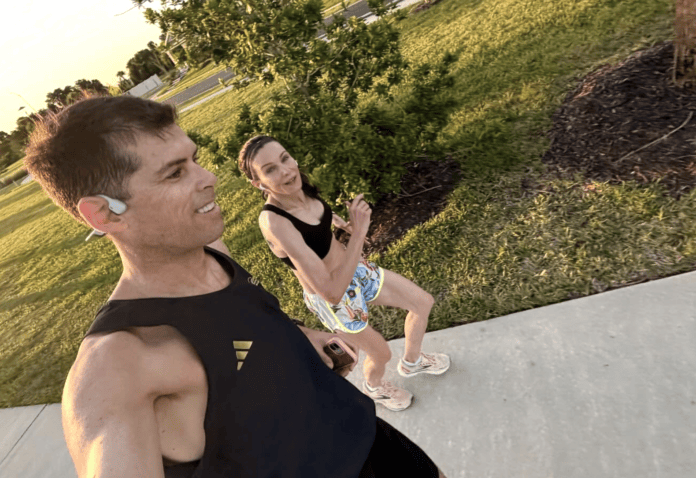
When Matt B logged onto our recording platform for this week’s segment of “Your Story, Your Why,” it felt less like a formal interview and more like catching up with an old friend. As someone who has followed Matt’s YouTube channel for years, I’ve always been drawn to his vibrant race vlogs and honest shoe recaps. But despite our crossing paths in the digital running space for quite some time, we had never truly peeled back the layers on what drives him to lace up day after day.
For Marathon Journal, this weekly series is about moving past the technical data of pacing charts or carbon-plate geometry to uncover the raw, deeply human motivations behind endurance sports. In a candid conversation spanning nearly twenty years of athletic history, Matt opened up about the intense learning curves, relationship dynamics, and hard-earned mental shifts that transformed him from a chaotic multi-sport competitor into a deeply grounded marathon veteran.
From Triathlons to 60+ Ultra-Distances
Matt didn’t start out his athletic life as a pure runner. Roughly two decades ago, looking to take an intentional step toward a healthier lifestyle, he found himself drawn to the world of multi-sport racing.
“I just liked the idea of being a triathlete,” Matt admits. “I thought being an athlete in one sport is fine, but being an athlete in three sports—that’s pretty admirable.”
He chased that admiration for years, competing in sprint triathlons, Olympic-distance events, and eventually half-Ironman races. However, his path completely shifted due to a mix of logistics, race-day romance, and an intimidating finish line. While participating in a half marathon down in Naples, Florida, Matt met his future wife. A few months later, he found himself waiting at the finish line of another marathon, intending to ask her out for a coffee date. He watched her cross the line in a staggering 3 hours and 12 seconds.
At the time, completely uninitiated into the world of 26.2-mile racing, Matt didn’t quite grasp what he was witnessing. “I just had no idea,” he laughs. “I’m like, ‘Is that a good time?’ I had never run a marathon… I didn’t really appreciate the effort that it takes to run a three-hour marathon.”
As they began dating, she gave him a straightforward piece of advice: “If you want to run better, you have to run more.” At the time, Matt was running 20 to 25 miles a week, thinking he was a “Billy Badass”. Motivated by her 25 marathons of experience, Matt signed up for the Miami Marathon as his first, targetting a 3:30 finish time. He crossed the line in 3:30:30—missing his goal by seconds, but unlocking a massive passion for the sport.
Today, the multi-sport days are long gone. Driven by the simpler logistics and friendlier environment of running, Matt has completed between 52 and 53 marathons, alongside more than 60 total endurance races of marathon distance or longer, including a phase dedicated to ultra-marathons and 100-mile trail runs.
The Hardest Lessons: Orthopedic Thresholds and the Comparison Trap
Accumulating over 60 ultra-distance finish lines doesn’t happen without a few setbacks. Looking back, Matt points to two massive learning curves that nearly broke him—physically and mentally:
- Respecting the “Orthopedic Threshold”: In his early enthusiasm for 50- and 100-mile trail races, Matt frequently pushed his weekly training volume into dangerous territory. He would ramp his mileage up to 100 miles a week before coming back down. “It would just ruin me, and I kept getting injured,” Matt reflects. After suffering several stress fractures, he learned that every individual has a unique orthopedic threshold. While elite or highly resilient runners online can sustain 90-mile weeks easily, Matt realized his body breaks down when staying above 80 miles for too long. Now, nearly 20 years into his journey, he listens tightly to his body, recognizing that his threshold for resilience sits closer to 70 miles a week as he navigates aging.
- Ditching the Internet Echo Chamber: Another major hurdle was overcoming the comparison trap. In his early days, Matt found himself watching other runners online, convincing himself that if they were running a certain mileage to get results, he needed to increase his own to match them. He also had to break the stereotype of what a “typical runner body” looks like. “I remember looking at the typical runner body—super skinny—and expecting them to be fast, and then getting blown away by tons of people that are not what you would think,” he notes. Today, he enjoys running significantly more because he trains loosely, listens to his own body, and lets go of what anyone else is doing online.
Navigating the “Dark Miles” and Redefining Success
With dozens of marathons under his belt, Matt has developed an incredibly intuitive mental strategy for handling the inevitable low points of a long race. He notes that experience doesn’t magically make the tough miles disappear; instead, it provides the psychological tools to know you will survive them.
His racing philosophy relies heavily on an ultra-running adage: Things are bad, but they aren’t always going to get worse. They will get better. Matt visualizes a marathon as a series of mental dips. In the beginning, you feel incredible, but as the miles add up, the negative dips get closer and closer together. Because he has been there before, he knows that even when his body screams at him to stop, he can simply slow down, take a drink at an aid station, and wait for the positive feelings to return.
Interestingly, Matt reveals that his personal best (PB) races are rarely the ones that bring him the most profound joy.
“The races that I’m most satisfied with my performance are when I’ve had to push through more mental barriers, physical barriers, and yet I still get to the finish line,” Matt explains. “I can always find the positive in something.”
At the Core: Forging Adult Discipline
When you peel back the outer layers of Matt’s running life, you find a foundational tool that literally restructured his adulthood.
As a youth growing up in the UK, Matt openly admits he wasn’t a good student. He hated school, skipped out on college or university, and simply took off traveling. Years later, after meeting his wife, she encouraged him to go back to school. Navigating higher education as an adult is an incredibly daunting task, but Matt found an unexpected ally in his morning runs.
“Running helped me stay focused and hone the discipline that I needed as an adult to focus on my studies,” Matt says. “I think I am more disciplined to sit still and study because I’ve built that discipline by running. Running isn’t easy… pushing through those dips and knowing it’s not the end of the world helped me just focus on my studies.”
Using the exact same mental fortitude required to grind out a grueling long run, Matt stayed focused through his studies, working his way from his Associate’s degree all the way through his Master’s degree.
Embracing Longevity and Community
As a fellow Florida runner navigating the swampy, pre-dawn humidity, I deeply resonated with Matt’s perspective on intentional longevity. He has successfully transitioned his running into an ageless pursuit. Rather than beating himself up over pace or trying to recreate the 7:30 easy miles of his youth, he is entirely content plodding along at a 10-minute mile, prioritizing joy and physical health over a stopwatch.
For Matt, running is his ultimate, sacred “me time”—a beautiful, self-chosen contrast to the rigid obligations of a daily job. And if he couldn’t run tomorrow? While he’d be disappointed, he notes that he would simply shift what he wants, pivoting his energy into the gym, the elliptical, and his creative love for making videos.
Ultimately, it is the community that keeps him laced up. The core group of runners who comment on his daily videos have become true friends. As we wrapped up our conversation, Matt left us with a beautiful reminder to leave our egos at the starting line:
“We will be a lot happier group as runners if we just focus on our own journey a little more… By that, I mean, if I go out and race against you, I’m really only racing against myself… Check your ego at the door. It’s not that big a deal, right? It’s only running. And at the same time, running is everything.”
You can watch Matt’s daily running and shoe vlogs on YouTube at It’s Matt B. Tune in to the latest episode of the Marathon Running Podcast to hear our full conversation, and let us know: How has running helped build discipline in your daily life?