

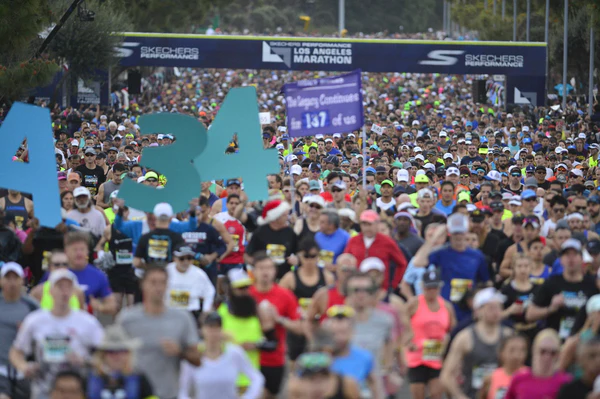
In endurance sport, the marathon holds a unique symbolic weight. The distance—26.2 miles—is not merely a logistical measurement but a cultural standard. For more than a century, the marathon has represented a test of preparation, endurance, and resilience. That is why a new policy introduced at the 2026 ASICS Los Angeles Marathon has sparked significant discussion within the running community: for the first time, participants will have the option to stop at mile 18 and still receive a finisher’s medal.
The change is framed as a safety precaution in response to expected heat on race day. Forecasts suggest temperatures will begin around 56°F at the 7:00 a.m. start and climb into the mid- to upper-70s by midday, conditions notably warmer than what sports scientists typically consider ideal for marathon performance. Organizers from the McCourt Foundation have emphasized preparation, hydration, and pacing as key strategies for managing the conditions. The course will feature 19 aid stations from mile 2 to mile 25, each offering water and electrolyte drinks, along with multiple medical stations along the route (McCourt Foundation, 2026).
But the innovation attracting the most attention is the option to finish early.
A Radical Adjustment to the Marathon Model
Under the new system, runners who choose to exit the race near mile 18—close to the Charity Half Marathon split on Santa Monica Boulevard—can still receive a medal recognizing completion of the event. Timing mats will record this result separately from official marathon finishers. The policy is intended as a heat contingency measure designed to reduce medical risk in the later miles of the race.
From a race management perspective, the logic is understandable. Heat has historically been one of the most dangerous variables in endurance events. Physiological strain increases sharply with rising temperatures, particularly late in the race when glycogen depletion and dehydration accumulate. For slower runners—those on the course five to six hours—the hottest part of the day could coincide with the final miles.
In that context, an early exit could prevent medical emergencies.
Yet the policy also raises a fundamental question: what does it mean to finish a marathon?
Safety Versus Symbolism
The marathon’s cultural power comes from its fixed challenge. Unlike shorter races, the distance itself is the achievement. The idea that one must cover the entire 26.2 miles is embedded deeply in the sport’s identity—from Olympic competition to local charity races.
Introducing an official alternative endpoint complicates that tradition.
Critics argue that awarding a medal at mile 18 risks blurring the distinction between finishing and not finishing. In most races, runners who stop early are recorded as DNFs (Did Not Finish). That classification is not a moral judgment; it simply reflects the structure of the event. By contrast, providing a medal for a partial distance could be interpreted as redefining completion itself.
Supporters counter that the medal in this case is not intended to equate with a marathon finish but to acknowledge participation under unusual conditions. In endurance events, organizers frequently adapt to extreme weather—delaying starts, shortening courses, or even canceling races entirely. From this perspective, the Los Angeles Marathon’s solution is a pragmatic compromise: preserving the event while offering a safer option for those struggling in the heat.
The “Silent” Risk of a Warm Marathon
The danger of Sunday’s race lies not in the starting conditions themselves, but in how deceptively comfortable they may feel. At 56°F, runners will begin the race in temperatures that appear ideal. That early comfort can create a subtle but significant tactical risk.
The McCourt Foundation explicitly cautions against this tendency: “The first few miles will feel cool and comfortable. That’s the most dangerous time to go out too fast” (McCourt Foundation, 2026).
From a physiological standpoint, this warning deserves careful attention. Heat does not simply slow pace; it fundamentally changes the metabolic cost of running. As temperatures rise, the body diverts blood flow toward the skin for cooling, reducing the amount available for working muscles. Heart rate climbs, sweat rates increase, and glycogen depletion accelerates. The result is that a pace sustainable in cooler conditions becomes progressively more expensive as the race unfolds.
This dynamic is why sports scientists often identify temperatures around 45–55°F as optimal for marathon performance. By the time the Los Angeles course approaches its final miles, temperatures could be nearly 15 degrees higher than that ideal window.
For runners who “bank time” early—a common but risky strategy in marathons—the consequences can be severe. The metabolic cost accumulated in the opening miles often reveals itself only later, when rising heat compounds fatigue and dehydration.
In that context, the organization’s guidance to “give yourself permission to adjust” is more than a motivational suggestion. It is a physiological requirement for navigating a race where conditions will change significantly over the course of several hours.
A Sign of the Climate Era?
There is another dimension to this decision: the growing influence of environmental conditions on race management.
Large marathons increasingly face unpredictable weather patterns, from heat waves to wildfire smoke. In recent years, several major races have shortened courses or issued heat advisories as temperatures climbed beyond historical norms. The Los Angeles Marathon’s approach may represent an early attempt to formalize contingency planning rather than improvise on race morning.
The event already emphasizes hydration and medical preparedness. Aid stations appear roughly every mile for most of the course, stocked with water and electrolyte drinks, while nine medical stations are positioned at key points along the route (McCourt Foundation, 2026).
Still, the mile-18 medal option moves beyond logistical preparation into the realm of redefining race outcomes.
The Psychological Dimension
For runners, the marathon is as much psychological as physical. Many participants spend months—or years—training for the distance. The final miles often represent the culmination of that preparation.
An official off-ramp at mile 18 could influence decision-making during the race itself. When fatigue and heat intensify late in the event, the existence of a sanctioned early finish may lower the threshold for stopping. In behavioral terms, the presence of an easier alternative can subtly reshape choices under stress.
Whether that shift ultimately improves safety or undermines the challenge of the marathon remains to be seen.
A Precedent in the Making
The Los Angeles Marathon is one of the largest marathons in the United States, drawing tens of thousands of runners each year. Decisions made at this scale often reverberate across the broader running industry.
If the mile-18 option proves effective—reducing medical incidents without causing major controversy—it could become a template for other races facing similar weather concerns. Alternatively, if athletes perceive it as diluting the meaning of a marathon finish, organizers elsewhere may hesitate to adopt the idea.
For now, the policy represents an experiment in balancing safety, tradition, and modern race management.
The marathon has always been defined by a simple premise: run 26.2 miles from start to finish. The Los Angeles Marathon’s new approach does not eliminate that challenge, but it does introduce a new possibility—that, under certain circumstances, the meaning of “finishing” may no longer be quite so straightforward.