Marathon Journal Feature Profile
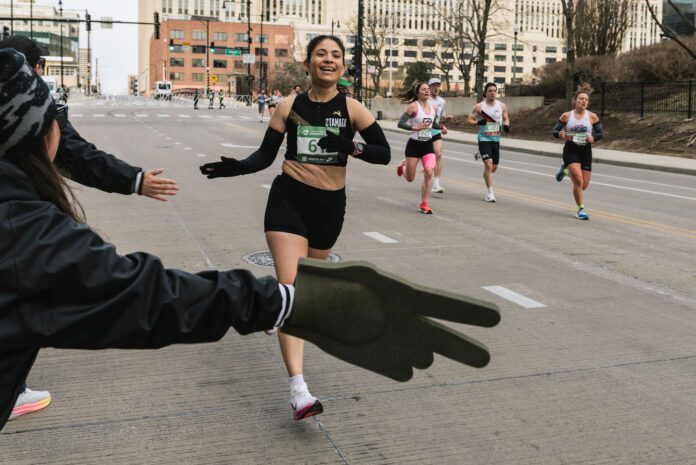
When you look at Maria Luevano, you might mistake her for one of the high school students walking the halls of the Jesuit high school where she works. But look closer, and you’ll find a powerhouse athlete, a mother of four , a school Vice President of Mission , and an Olympic Trials chaser who is fundamentally changing the narrative of what it means to be a Latina in the endurance space.
I first met Maria in Boston at a Tracksmith Stamata event, where she stood out as one of the featured athletes in a documentary highlighting women fighting for an Olympic Trials Qualifying (OTQ) time. In a sport where elite spaces often feel hyper-manicured and unreachable, Maria immediately felt like family. Her kids were in the background of the film saying beautifully illogical things about running—a reality any running parent understands instantly.
But behind the relatable warmth is a blistering competitor who runs a sub-3-hour marathon pace while refusing to lose her grip on the human side of the sport.
The Escape and the Ignition
Remarkably, Maria didn’t grow up running; her journey didn’t start until 2016. Before lace-up shoes entered the picture, her life was entirely dedicated to others—doing extensive youth ministry with her husband and serving her community as a passionate educator.
“Running kind of glues everything together for me because that is probably the only one thing that I do for myself, by myself,” Maria confesses. “Everything else that I do at home or in my school, I’m working with others for others. Running is mine.”
The spark happened during her first summer as a full-time teacher. Used to the intense structure of the school year, she suddenly found herself navigating the beautiful but relentless chaos of being home 24/7 with her children.
“One afternoon, my first summer at home with them, my husband came home. I asked him for a little relief, and I went out for my first run by myself,” she recalls. “I honestly had no idea that I was starting to build something so special and so meaningful for me.”
Navigating the Blackout: Finding Resiliency in the Dark
Maria’s progression from casual runs to the upper echelons of the sport happened organically. A sub-4-hour marathon quickly melted into a Boston Qualifier, which soon turned into chasing sub-3-hour clockings.
“It’s intimidating to put such a big goal out there because it is a big goal,” Maria says regarding the Olympic Trials. “That being said, I believe it’s better to try it and not quite get there than not trying it because you’re too afraid or too intimidated.”
But chasing boundaries means occasionally hitting a wall. Last year, in the buildup to the Chicago Marathon, the accumulation of heavy racing caught up to her. During a tune-up half marathon, feeling fitter than ever, she went out at a blistering pace.
By mile eight, her body was completely depleted. What followed was a runner’s nightmare: a total physical blackout.
“I do not remember anything about the last couple of miles of that race,” Maria reveals. “My finish line pictures are two male runners holding me because I couldn’t hold my body anymore. I ended up in the medical tent needing fluids.”
While the experience was terrifying and required extensive medical follow-ups to ensure she was safe, it revealed a deeper truth about her character. She wanted to quit at mile eight, but some internal autopilot carried her to the timing mat.
“It showed me that I have an internal strength that is beyond my own comprehension,” she says. “As runners, we handle pain in a very different way.”
Breaking Latina Stereotypes
For Maria, the hurdles aren’t just physical—they are cultural. As a Latina runner, breaking into a sport that traditionally lacks minority exposure at a young age requires navigating deep-seated family dynamics.
“My mom never understood why I wanted to run while I was pregnant. She thought it was very dangerous. She thought I was being really irresponsible,” Maria says, noting she ran all the way to 39 weeks with her third pregnancy. “Every time I came back from a run, I almost could hear my mom giving me a lecture.”
Even when transitioning to the competitive elite tier, family cultural expectations linger. “My first marathon, everyone was on the course. Twelve marathons in, if I get my husband and the kids to come out, I’m lucky! But they let me do what I like, and I know they’re supporting me.”
By continuing to show up on starting lines, Maria knows she is directly altering the narrative for the next generation of minority women.
Peeling Back the Layers of ‘Why’
When asked to strip down the layers of why she subjects her body to the rigorous demands of OTQ training, Maria’s answer always circles back to legacy and roots.
- Her Children: “My children are my why. I want them to see an example of perseverance, hard work, and resiliency. If you have a goal and work really hard, either you’ll get it or you’ll learn a ton and become a better version of yourself in the process.”
- Her Roots: “My parents are immigrants, and I’m an immigrant myself. My dad passed away a little over ten years ago, but I saw what a hardworking person he was. My why is to continue that legacy and that hard work ethic he taught me.”
- Pure Curiosity: “I just have the curiosity to see how fast I can run and see what is possible for this girl. I refuse to walk away from a big opportunity because I’m scared.”
Beyond the PR: Stage Two of Running
As the running community witnesses a golden era of master’s runners setting personal records well into their forties, the pressure to constantly run faster can become a toxic metric. Maria, who is currently working through a plateau on an older marathon PR, views the aging process not with anxiety, but with excitement.
“I work with a therapist and I’ve been working really hard with her on thinking of different goals,” Maria shares openly. “If we can’t think of a PR during this race, perhaps we can focus on fueling, or on mental strength. Having different goals that are not tied to our times is a healthy approach.”
“When I am no longer in that space to chase times, I think I’ll still love running because I love the sport because of what it gives me. I don’t think a time defines who we are, or makes anyone more valuable than anyone else. I’m actually excited for that stage two of running.”
Listen to the Full Conversation & Catch the Clips
Catch the full audio interview with Maria Luevano on the premiere episode of Your Story, Your Why, dropping this Thursday on the Marathon Running Podcast audio feed.
Available on Spotify, Apple Podcasts, and right here on MarathonJournal.com. Want to see the face behind the voice? Head over to our Instagram @RunningPodcast and @MarathonJournal_ to watch video highlights and behind-the-scenes clips from our chat!
Want to share your running journey? We want to hear the raw, unfiltered truth behind your miles. Head to our submission tab to tell us your ‘Why’ and be featured next. Email us at contact@marathonjournal.com