
There is an unspoken rule in the modern running community that to build a massive digital following, you must constantly perform. You have to pitch the latest carbon-plated super shoe, engineer the perfect viral hook, and curate an aesthetic that feels more transactional than inspirational.
Then there is Tommie Runz.
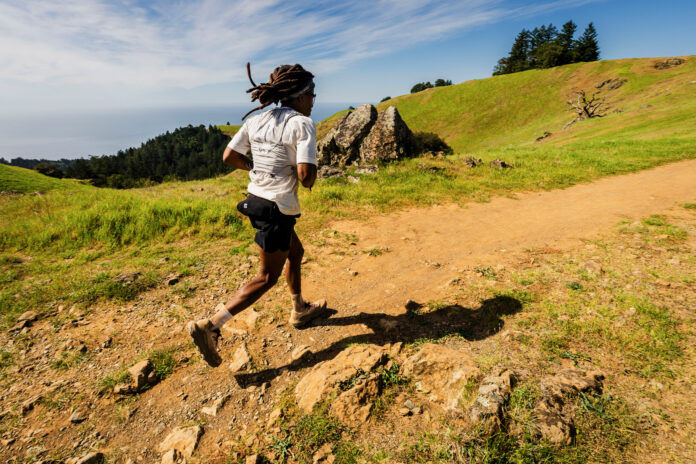
If you stumble onto his platforms, you will immediately see four words standing side-by-side in his bio: Black. Sober. Vegan. Runner. From a historical standpoint, those subcultures rarely cross paths in commercial sports media. But for Tommie, setting that intention up front isn’t a marketing strategy—it’s a lifestyle, an invitation, and a shield. It draws in people who look like him to show them they belong on the trails, and it forces corporate brands to respect exactly who he is before they ever slide into his DMs.
Eight years after his journey began, the runner formerly known as “Tommy Guns” just tackled the grandest stage in ultra running: the legendary Western States 100-Mile Endurance Run.
The Baseline: Trading Suffering for Strategy
Before he was an ultra-marathoner traveling the world to inspire others, Tommie was navigating the dark, exhausting reality of high-functioning alcoholism. He had the career, the family, and the outward appearance of stability, but internally, life was a cycle of feeling physically ill and emotionally spent. The turning point wasn’t a dramatic court order; it was a deeply personal reflection on his father, an alcoholic who passed away from a stroke at just 39 years old. Wanting a different legacy for his own children, Tommie walked through the doors of Alcoholics Anonymous in 2017.
To fill the void left by alcohol, he initially threw himself into lifting weights six to seven days a week under the moniker “Tommy Guns.” But the vanity of the weight room left him unfulfilled.
“When you’re lifting weights, it’s very vain,” Tommie reflects in a raw interview on marathonjournal.com. “Everything is about how you look, like a thirst trap. When running came along, I would post about running three or four miles. It felt like I was onto something new. The attention didn’t feel so shallow. It felt meaningful.”
In 2018, he officially changed his handle to Tommie Runz. He hasn’t looked back since.
When asked how his past with alcoholism shapes his current relationship with distance running, his perspective on endurance training is masterfully sharp:
“Why I run every day is just because that’s what I’ve committed to… For a long time when it came to alcohol, I didn’t necessarily have a choice. It was just kind of suffering for suffering’s sake, really. This is suffering that I get to choose. This is suffering that if you do it properly over and over, you get really good at the final thing.”
From a 3:13 Debut to the Speed Project Solo
Tommie’s entry into the marathon world was nothing short of a vertical trajectory. Guided by his coach from day one, he aimed to qualify for Boston before he had ever even completed a 26.2-mile race. He clocked an incredible 3:13 at the Detroit Free Press Marathon for his debut, later lowering his personal best to a blistering 2:44:46 at the Glass City Marathon after training through the pandemic.
But marathons quickly multiplied. He tackled four marathons in a single year during a self-styled “Redemption Tour,” eventually expanding his tolerance for extreme volume until an unimaginable invitation came his way: The Speed Project.
The Speed Project is an unsanctioned, lawless footrace stretching 340 miles from Los Angeles to Las Vegas. While most athletes attack it as a relay team, Tommie was asked if he wanted to run it solo.
“I told three people separately, and they all asked if I was doing it solo,” Tommie says. “I said no so fast that I had to check myself. I thought, Wait, why am I saying no so fast? Is it because I think I can’t do it?“
He committed to the solo journey, transforming it into a fundraising vehicle that raised thousands of dollars for the Release Recovery Foundation to provide rehab scholarships. Tommie chose the original, unmodified route. For six grueling days, from 5:00 AM until late into the night, he stripped away the metrics and simply stayed outside.
The physical challenge was met with acute emotional weight. Just seven days before the start, Tommie’s best friend passed away from a drug overdose. While his friend was being laid to rest back home, Tommie was walking through Death Valley, processing grief, mortality, and his own purpose in real-time. He finished the 340 miles, becoming one of only a handful of people in history to conquer the solo OG route.
The Ultimate Peak: Conquering Western States
Conquering the Speed Project fundamentally rewired Tommie’s brain, shifting his curiosity entirely toward the ultra-trail world. After securing his qualifying ticket to the Western States lottery by running a spectacular 19 hours and 4 minutes at the Javelina Jundred, the real work began.
For the uninitiated, the Western States 100 is the pinnacle of ultra-marathon racing—an exclusive, historic 100-mile journey through California’s rugged canyons where runners face bone-rattling descents and suffocating summer heat. With only roughly 400 spots available each year, merely standing on the starting line is a badge of ultimate prestige.
Training from Michigan—a notoriously flat region—presented major logistical hurdles. To prepare his legs for the devastating canyon descents and mountain climbs, Tommie had to adapt by leaning heavily on strength training in the gym, back-to-back long runs, grueling 3.5-hour treadmill sessions, and strict sauna protocols to mimic the California heat.
Going into the race, his goal was locked onto the coveted silver buckle. “I definitely want to break 24 hours and get the silver buckle,” Tommie noted before heading to California. “But to be honest, I want to be well under 24.”
An Invitation to the Track
True to his core ethos, Tommie didn’t want to cross this historic finish line in isolation. The Western States 100 famously concludes with a final lap around a local high school track in Auburn, California. While most elite runners share that final stretch exclusively with their immediate crew, Tommie issued an open invitation to the running community to join him for the final mile.
It was the perfect exclamation point to a long, winding road. Tommie Runz isn’t running to sell you a shoe, and he isn’t running to show off. He is running because he chose this suffering, and he wants to show anyone watching that you can always rewrite your own narrative.
To read more elite athlete profiles and keep up with our post-race coverage, visit the full archives at marathonjournal.com.