

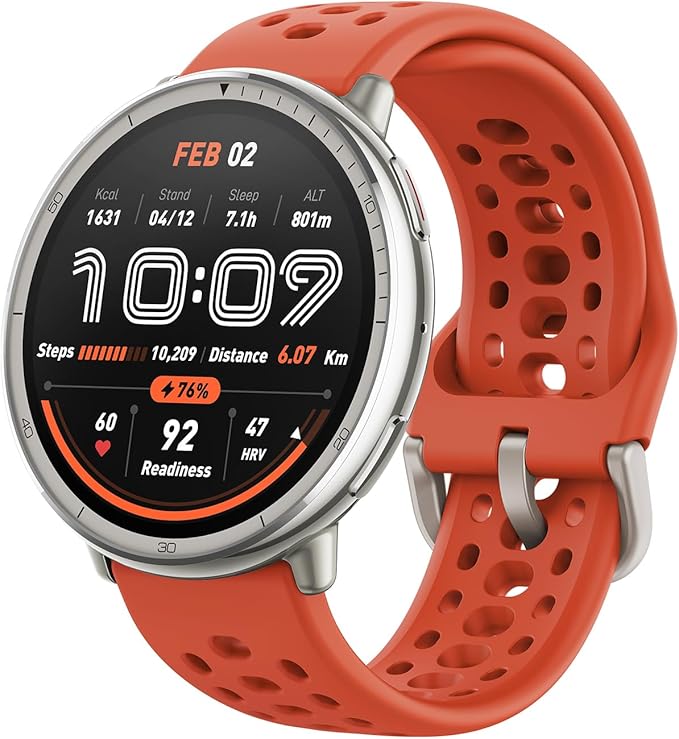
When running gear prices keep climbing past the $500 threshold and everyday training budgets are tighter than ever, choosing a smartwatch usually means choosing between two bad options: dropping a minor fortune on a high-end multi-sport device, or settling for a cheap lifestyle tracker that loses GPS signal halfway through a long run.
The Amazfit Active 2 is attempting to rewrite that math. Priced under $130, it packs high-end features—like built-in GPS, offline GPX mapping, and a 10-day battery—that traditionally demand a luxury price tag.
We put the Active 2 through high-mileage testing to determine if it is a legitimate training tool or just another budget compromise.
Model and Purpose
The Amazfit Active 2 is positioned as a hyper-efficient data tool for the budget-conscious athlete. It is specifically designed for:
- High-Volume Marathoners: Athletes who require multi-day battery life and reliable tracking for marathon blocks without the premium price tag.
- Navigation-Dependent Runners: Trail or city-based runners who need GPX route importing and breadcrumb navigation.
- Minimalist Data Users: Runners who want essential performance metrics (pace, heart rate, cadence) without the bloatware of social media features.
Specs and Measurements
- Price: $99.99 (Standard version; Premium tier with sapphire glass and leather strap sits at $129.99).
- Weight: ~29.5g (chassis only), engineered for a lightweight, near-invisible profile.
- Display: 1.32-inch round AMOLED, reaching up to 2,000 nits peak brightness.
- Battery Life: 10 days (typical usage); up to 21 hours (continuous GPS tracking).
- Water Resistance: 5 ATM (tested for sweat-soaking, heavy rain, and swimming).
Key Features
- Ultra-Bright AMOLED Utility: The 2,000-nit screen isn’t just for looks; it’s for data legibility. During midday intensity sessions, split times and heart rate zones remain visible without manual adjustment or shielding the screen.
- Offline Mapping & GPX Integration: Through the Zepp App, users can push GPX files directly to the watch. This allows for reliable breadcrumb navigation on unfamiliar routes or race courses, functioning independently of phone proximity.
- The “Zero-Chafing” Chassis: The design prioritizes comfort over the 20+ mile mark. The low-profile framing and refined strap materials ensure there is no friction or skin irritation during high-mileage blocks.
On-Wrist Experience
Step-in comfort is high—the watch sits flush on the wrist, making it aerodynamic and easy to tuck under long-sleeve winter gear.
In testing, the watch performed reliably for steady-state aerobic miles, with GPS tracking proving surprisingly solid against higher-end competitors. However, it is important to note the technical limitations: the optical heart rate sensor can exhibit a slight lag or variance during rapid high-intensity interval training (HIIT) or sudden surges. Furthermore, those who require standalone cellular (LTE) connectivity for live-tracking will still need to carry a smartphone.
The Competition: Garmin Comparison
For those weighing this against the Garmin ecosystem, the Amazfit Active 2 competes most closely with the Garmin vívoactive 5.
- Choose the Amazfit Active 2 if: You want premium screen tech (2,000 nits) and mapping for under $130.
- Stick with a Garmin vívoactive 5/6: If you are already deeply invested in the Garmin Connect ecosystem and prioritize advanced recovery metrics (Body Battery, HRV Status) over raw hardware specs.
- Move to a Garmin Forerunner 165/265: If you are a dedicated marathoner who requires advanced “Training Load” and “Race Predictor” analytics that go beyond simple time/distance tracking.
Final Verdict
The Amazfit Active 2 is a rare “budget” watch that doesn’t feel like a compromise. It offers the essential tools needed for serious training blocks at a fraction of the cost of dedicated sport-specific devices.
Choose the Amazfit Active 2 if:
- You prioritize core performance data over “lifestyle” social features.
- You need a long-battery device for heavy training weeks without breaking the $100 threshold.
- You require GPX route importing for navigation.
Stick with a Premium Multi-Sport Watch if:
- You require sub-second heart rate accuracy for HIIT and complex interval protocols.
- You require standalone cellular (LTE) connectivity for safety.