
Cupless racing is beginning to move from concept to reality in major road marathons, and Chicago is among the latest to take a step in that direction.
The Chicago 13.1 and Chicago Marathon will test refill stations on course, signaling a broader shift in how races are approaching hydration and sustainability. While the races will not go fully cupless, the move reflects growing interest among major events in reducing reliance on single-use cups.
The approach follows the Paris Marathon, which became the first large-scale road marathon to eliminate disposable cups entirely. Despite initial skepticism, the transition was largely successful.
“From our opinion, it went swimmingly,” said Jen Krupey, Vice President of Marketing and e-Commerce at Hydrapak, which partnered on the initiative. “Sure, there were a couple of hiccups… but for the most part, the race executed it pretty flawlessly.”
What Cupless Racing Means
In a cupless racing model, aid stations no longer distribute disposable cups. Instead, runners are expected to carry their own hydration—either in handheld bottles, soft flasks, or reusable cups—and refill at designated stations along the course.
“It’s not using cups that get thrown into the trash or end up in landfills,” Krupey explained. “And instead having runners carry their own hydration and refill along the course.”
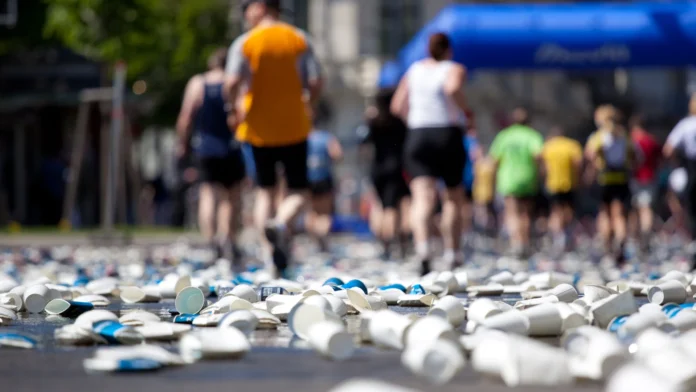
The environmental rationale is significant. While exact figures vary, estimates suggest that runners may use multiple cups per aid station, with large marathons purchasing millions of cups for a single event.
“Our research points to a minimum of three to four cups per person per aid station,” Krupey said. “I’ve heard that some of these world majors are buying upwards of 2 million cups.”
Testing, Not Replacing—Yet
Chicago’s decision to introduce refill stations without fully eliminating cups reflects a cautious, transitional approach.
Rather than forcing immediate adoption, races are experimenting with hybrid systems that allow runners to choose between traditional aid stations and refill options. Similar testing is underway in other major marathons, including New York.
The goal is to evaluate logistics, runner experience, and operational efficiency before making broader changes.
How Refill Stations Work
There is no single model for cupless aid stations, and race organizers are actively testing different formats.
Some setups rely on self-serve systems with multiple spouts connected to large water sources, allowing runners to fill their own bottles. Others use volunteers with pitchers, similar to traditional aid stations but without disposable cups. Hybrid approaches combine both methods.
“I think the beauty… is that races are testing a lot of different models,” Krupey said. “We’re in this phase of figuring out what makes the most sense.”
Early observations suggest that execution—particularly the number of refill points and station layout—plays a critical role in minimizing congestion.
Concerns Around Runner Experience
Despite the environmental benefits, cupless racing raises practical concerns for runners.
Many are reluctant to carry additional gear, particularly in crowded races where space is already limited. Others question whether the shift reduces the level of support traditionally expected from race organizers.
Krupey acknowledged the concern.
“I totally understand that there are a lot of runners… who feel like this is going to screw up their run,” she said. “I can’t argue with someone who feels that way.”
However, she noted that adaptation is possible, pointing to trail running as an example where carrying hydration has long been standard practice. Runners who train with hydration systems often find that it becomes routine over time.
Congestion and Course Flow
Another key concern is congestion at aid stations, particularly in large races with dense fields.
Observations from Paris suggest that bottlenecks are not inherent to cupless racing but instead tied to station design.
“The only backup I saw was when they didn’t have enough spouts,” Krupey said, noting that increasing refill capacity can alleviate delays.
While runners may need to slow down to refill, this is not entirely different from traditional aid stations, where grabbing cups at speed often results in spillage and inefficiency.
The Question of Waste
Critics have also pointed out that cups are only one part of a race’s environmental footprint, which includes items such as finisher gear, packaging, and travel-related emissions.
Hydration-focused initiatives, however, target one of the largest and most visible sources of waste on race day. Broader sustainability efforts—such as reusable gear bags or opt-out options for race materials—are being explored separately across the industry.
Reusable Solutions and Their Limits
At Paris, runners were provided with reusable cups designed for continued use beyond race day. While this approach reduces immediate waste, it introduces a new challenge: ensuring that these items are reused rather than discarded.
“These aren’t meant to be put in landfills,” Krupey said. “They’re meant to be used again.”
Efforts are also underway to improve recyclability and explore alternative materials, though questions remain around cost, sanitation, and long-term sustainability.
A Gradual Shift
Cupless racing is still in its early stages, particularly in road marathons. The transition presents logistical, cultural, and practical challenges for both runners and race organizers.
However, with major events like Paris implementing the model and races like Chicago beginning to test it, the direction is becoming clearer.
Rather than a sudden overhaul, the shift is unfolding gradually—through testing, feedback, and incremental change.
As more races experiment with refill systems, cupless racing is likely to become an increasingly familiar part of the marathon experience.
The Marathon Journal Challenge: Putting It to the Test
While the industry continues to debate the logistics of cupless racing, we want to know how it feels on the ground. To get a true sense of the runner experience, a Marathon Journal staff member will be running the Chicago Marathon while committing to the cupless model in its entirety. They will carry their own hydration from start to finish, navigate the newly implemented refill stations, and report back on everything from pack management to time-impact and overall flow. Stay tuned for their full race report and a candid look at whether the cupless future is as seamless as the experts promise.