
If you have spent enough time around running watches, you eventually realize that more features don’t necessarily make a better running watch. What matters is whether the watch gives you the information you need, when you need it, without getting in the way of the run.
That is the exact philosophy behind the Suunto Run 2.
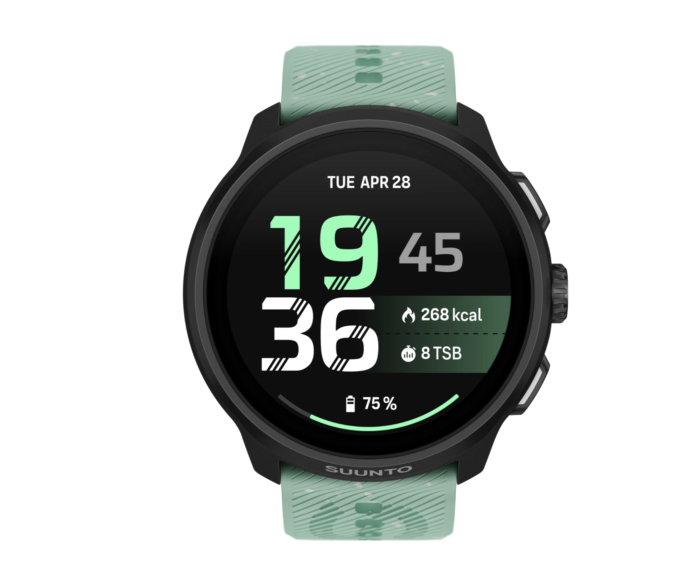
Priced at $349 for the 4GB version and $399 for the 64GB version, the Run 2 is a lightweight, running-focused GPS watch built around a 2,000-nit AMOLED display, dual-band GNSS, upgraded wrist-based heart-rate tracking, free worldwide offline maps, marathon-focused tools, and offline music playback.
The watch body weighs just 35 grams, with the complete watch and supplied silicone strap weighing 53 grams. It measures 46.5 × 46.5 × 11.66 mm and utilizes a stainless-steel bezel, Gorilla Glass, and 5 ATM water resistance.
Following earlier Marathon Journal coverage of the Suunto Race S as part of Suunto’s push into performance distance running, the Run 2 takes a distinct approach. Rather than trying to be a heavy outdoor adventure computer, it places road and trail running squarely at the center of the experience.
Key Specifications & Build Quality
- Price: $349 USD (4GB storage) | $399 USD (64GB storage)
- Weight: 35 g case | 53 g with supplied silicone strap
- Dimensions: 46.5 × 46.5 × 11.66 mm
- Display: 1.32-inch LTPS AMOLED (466 × 466 pixels), up to 2,000 nits peak brightness
- Lens & Bezel: Gorilla Glass lens with a stainless-steel bezel
- Water Resistance: 5 ATM (50 meters)
- GPS & Navigation: Dual-band (L1 + L5) GNSS (GPS, GLONASS, Galileo, BeiDou, QZSS) with free downloadable worldwide offline maps
- Heart Rate: Updated 12-channel optical heart-rate sensor array
- Audio & Storage: Offline local music playback (MP3/WAV storage) with 4 GB or 64 GB internal capacity
- GPS Battery Life: Up to 24 hours (dual-band/all-systems GNSS), 30 hours (single-band GNSS), up to 40 hours (power-saving GPS modes)
- Smartwatch Battery Life: Up to 13 days in daily smartwatch mode; rated at approximately 10 days for typical daily training use
The Runner’s Perspective: What Works Exceptionally Well
1. The 2,000-Nit AMOLED Display
The most immediate standout on the Run 2 is the screen. The 1.32-inch AMOLED display reaches up to 2,000 nits, making it substantially brighter than earlier 600-nit panels. Pace, heart rate, distance, and workout information remain effortlessly readable with a quick glance under direct midday sunlight without requiring you to break stride. Featuring a sharp 466 × 466 resolution, text and map details remain crisp in all lighting conditions.
2. Lightweight Design for Long Distance
Suunto lists the watch case at just 35 grams, with the complete unit weighing 53 grams on the scale. Measuring 11.66 mm thick with a standard 22 mm silicone strap, the watch maintains an exceptionally low profile. For marathon builds logging high weekly mileage, lightweight hardware eliminates the wrist-bobble and skin friction common with chunkier outdoor units during 20-mile long runs.
3. Dual-Band GNSS Precision
The Run 2 utilizes dual-band (L1 + L5) GNSS and supports five major satellite systems (GPS, GLONASS, Galileo, BeiDou, QZSS). This hardware array provides superior track fidelity through difficult environments, including urban canyons surrounded by skyscrapers, dense tree canopies, and winding routes. Satellite acquisition is rapid, maintaining accurate real-time pace readouts and tight route mapping.
4. Upgraded 12-Channel Heart-Rate Sensor
Suunto redesigned the optical heart-rate system for the Run 2, implementing a 12-channel sensor array paired with redesigned sensor glass. Independent testing indicates strong tracking fidelity during steady-state aerobic efforts and progressive tempo runs. While optical wrist sensors can still experience brief latency during sharp interval surges compared to a dedicated chest strap, the updated sensor represents a noticeable improvement in cadence-lock resistance.
5. Free Worldwide Offline Maps
At the $349 price point, native offline mapping is a major market disruption. Suunto provides free worldwide offline topographical maps that download directly to the watch via Wi-Fi. Runners gain street names, topographical contours, and spatial context right on the wrist without needing a cellular connection or a smartphone. For athletes traveling to destination marathons or exploring unfamiliar training routes, it provides essential navigation out of the box.
6. Race-Day Pacing: Marathon Time & EnergySense
The Run 2 introduces features tailored directly to race execution:
- Marathon Time: Uses current real-time pace to project finish times dynamically, giving runners an immediate, math-free look at target pace variances during late race miles.
- EnergySense: A feature designed to estimate real-time energy output relative to remaining capacity during long training blocks and race efforts, serving as a secondary effort metric alongside heart rate and perceived exertion.
7. Onboard Offline Music
The Run 2 supports native offline music playback. Athletes can load MP3 or WAV audio files directly to the watch’s internal storage (4GB or 64GB) and pair Bluetooth headphones for phone-free running. Note: While it handles local file playback, it does not support third-party offline streaming apps like Spotify.
Where It Falls Short: Limitations & Trade-Offs
- Focused Running Tool vs. Hybrid Smartwatch: The Run 2 prioritizes athletic performance over daily lifestyle features. It does not include contactless payments, cellular connectivity, or a third-party smartwatch app store.
- Battery Life Context: While the watch offers up to 24 hours of continuous dual-band GPS tracking and up to 13 days of daily smartwatch use (or ~10 days of active training use), heavy utilization of always-on display modes, navigation maps, and local music playback will naturally decrease total uptime between charges.
- Gorilla Glass Lens: To keep the weight down to 35 grams and maintain the $349 entry price, Suunto utilizes Gorilla Glass over the display rather than sapphire crystal. While highly durable for road and light trail use, extreme trail runners in rocky environments should consider a screen protector.
- App Ecosystem Learning Curve: The accompanying Suunto mobile app provides clean workout analysis, HRV tracking, and route planning, but athletes transitioning from other ecosystems may require a brief adjustment period to navigate its structured workout tools and data organization.
The Ecosystem Factor: Third-Party Syncing
A common hesitation when evaluating new running hardware is the fear of losing historical training data or being trapped in a proprietary app. The Suunto Run 2 connects seamlessly with industry-standard platforms, including Strava and TrainingPeaks. Workouts, route files, and split data export automatically upon completing a run, allowing athletes to maintain their existing training logs uninterrupted.
The Verdict
The Suunto Run 2 is a hyper-focused running watch built around the exact metrics endurance athletes use during a training block.
For $349, the 4GB base model delivers a 2,000-nit AMOLED display, dual-band GNSS, an upgraded 12-channel optical heart-rate sensor, free offline topographical maps, offline music playback, and targeted marathon pacing tools in a 35-gram case. The $399 64GB model offers high-capacity storage for extensive map regions and audio libraries while keeping the exact same lightweight chassis.
Bottom Line: If your priority is road training, race execution, accurate navigation, and a lightweight watch that disappears on the wrist during long miles, the Suunto Run 2 stands as one of the most compelling value propositions in performance running tech.