

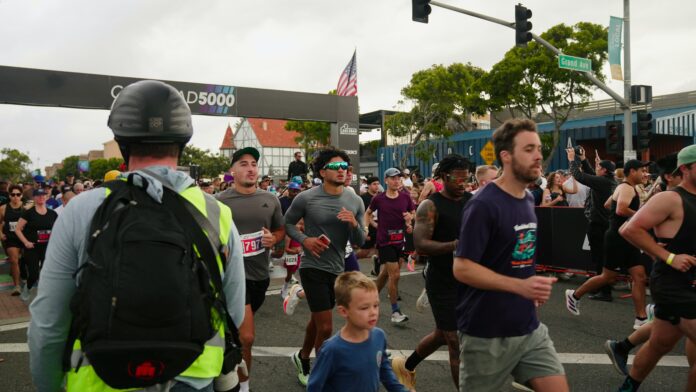
Before the oven timers start or the afternoon football kickoffs begin on Thursday, November 26, more Americans lace up their running shoes than on any other single day of the year. Across all 50 states and Washington, D.C., Thanksgiving morning belongs to the Turkey Trot, an annual ritual that blends local charity fundraising, family tradition, and the simple gratitude of being healthy enough to cover a few miles before breakfast.
While major fall marathons grab the elite headlines, Thanksgiving Day remains the true participation engine of American road running, and the science behind gratitude explains why so many runners feel noticeably better long after crossing the finish line.
By the Numbers: A Record-Setting Holiday Tradition
Industry participation data shows just how big Thanksgiving morning has become for road running, with every participant and fundraising figure below linked directly to its source report:
- 1,330,726 participants across 1,056 Thanksgiving Day races: According to RunSignup’s 2025 Turkey Trots Report, Thanksgiving events on the platform saw an 11 percent per-race growth rate and 1,260 average participants per race (up from 1,109,909 participants across 936 races in 2024, per RunSignup’s Turkey Trot data).
- 37 percent with 1,000+ participants and 94 percent race-morning turnout: The RunSignup 2025 Turkey Trots Report shows 389 events (37 percent) drew more than 1,000 participants, 4 percent exceeded 5,000 participants, and 94 percent of checked-in registrants showed up on race morning.
- More than $3.17 million raised across 76 percent of races: The RunSignup 2025 Turkey Trots Report recorded $3,175,111.51 in donations across 76 percent of Thanksgiving Day races on the platform, supporting local food banks, shelters, and community nonprofits.
- Distance breakdown (91 percent 5K, 24 percent kids dash, 21 percent 1-mile, 12 percent 10K): Per the RunSignup 2025 Turkey Trots Report, the 5K anchors nearly every Thanksgiving slate alongside family-friendly kids dashes, one-mile runs, and 10Ks.
Notable Turkey Trots and Verified Participation Benchmarks
From neighborhood park loops to major downtown street closures, several flagship races anchor Thursday morning’s nationwide slate:
- ThunderCloud Subs Turkey Trot (Austin, Texas): Local news coverage from KVUE reported a record 26,000 registered participants for the 35th edition of Austin’s five-mile Thanksgiving tradition benefiting Caritas of Austin.
- Manchester Road Race (Manchester, Connecticut): The 2026 Manchester Road Race participants roster tracks live 2026 entrants (showing more than 14,300 participants listed ahead of race day), while Manchester Road Race 2026 news releases report that the Little Manchester Road Race drew 1,000 young runners and set a new food donation record.
- Run to Feed the Hungry (Sacramento, California): Confirmed for its 33rd edition on November 26, 2026 via the Run to Feed the Hungry official site and 2026 Race Roster registration page, serving as one of Northern California’s largest Thanksgiving charity runs supporting the Sacramento Food Bank.
What Runners Are Grateful For (And Why It Actually Improves Performance and Health)
Beyond finish times and split alerts, Thanksgiving offers a rare pause in a sport obsessed with the next training block, weekly mileage totals, and watch metrics. Research into the psychology and physiology of gratitude shows that shifting focus toward appreciation does far more than boost holiday mood.
According to UCLA Health’s review of gratitude research, practicing gratitude activates the parasympathetic nervous system, helping lower heart rate, blood pressure, and cortisol while interrupting repetitive worry. The American Brain Foundation also notes that regular gratitude practice correlates with improved heart rate variability (HRV), deeper sleep, and stronger emotional resilience, while a systematic review and meta-analysis published via the National Institutes of Health (PMC) found measurable improvements in life satisfaction, positive mood, and anxiety and depression symptoms across gratitude interventions.
For runners, those benefits map directly onto the parts of the sport that sustain us through long training cycles:
- Gratitude for a body that shows up on ordinary days: Every runner eventually deals with an injury detour, an illness, or a race that unravels late. Stepping onto a local start line with healthy legs, even when fitness is not at an all-time peak, is never guaranteed, and framing runs around what your body can do rather than what your watch says lowers pre-race stress and burnout.
- The volunteers standing in the dark at 6:00 a.m.: Behind every smooth 5K, half marathon, or marathon sits an army of race directors, course marshals, medical crews, and aid station volunteers who stand out in cold November mornings handing out water cups and cheering for strangers.
- Training partners, pacers, and running clubs: Solo miles build discipline, but the people who meet you in the dark before work, hold steady pace when your legs start fading, and celebrate finish lines regardless of the clock are what keep runners coming back year after year.
- A low-barrier front door into the sport: Unlike major marathons with lotteries and qualifying standards, Thanksgiving morning races welcome sub-elites, stroller pushers, costumed families, and first-time 5K walkers on the exact same course, turning a holiday morning into the starting line for tens of thousands of new runners.
- The quiet reset before the next goal: Whether Thursday morning means chasing a fast 5K split, jogging alongside family, or logging an easy solo loop before dinner, gratitude turns running from a constant performance test back into something we get to do.
At its core, Thanksgiving morning shows the best side of road racing: millions of people trading screen time and stress for fresh air, neighborhood energy, charitable support, and shared movement before the holiday table fills up. Long after the turkey leftovers are packed away and the 2027 training plans begin, carrying that appreciation for healthy legs, supportive crews, and everyday miles is what keeps runners showing up year after year.