

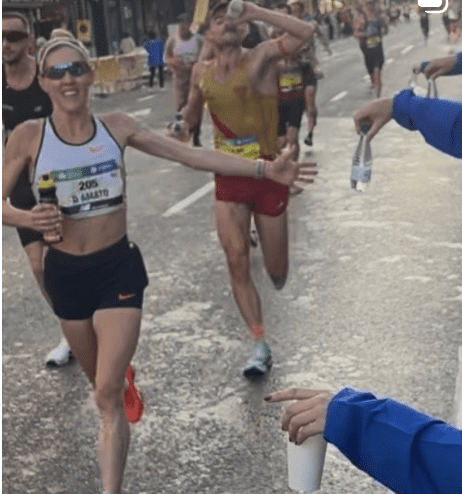
Most runners know Keira D’Amato as the realtor-turned–American record holder. But in our recent conversation for Marathon Journal, we deliberately skipped the origin story. There is enough written about how she got here. What matters now is how she operates.
Linked here are the podcast and YouTube if you prefer to jump to the podcast or jump to the video on YouTube, you can do so directly within the feature.
With a background in mathematics and years of experience at the highest level of the sport, D’Amato approaches marathoning less as an act of suffering and more as a problem to be solved. Her current training — shaped by age, experience, and a move to Utah under coach Ed Eyestone — offers a revealing look at where elite marathon preparation is heading.
This is not about chasing mileage for its own sake. It’s about efficiency, durability, and learning how to work through fatigue — physically and mentally — without breaking down.
For runners looking to train with an elite mindset without paying the price of elite mileage, D’Amato’s “Utah era” provides a masterclass.
Rethinking Elite Marathon Training: Fatigue Before Pace
The defining challenge of the marathon has always been the same: the final third of the race. Miles 16 through 26 are where fitness, decision-making, and durability intersect.
Traditionally, elite marathon training has addressed this with long stretches at marathon pace layered deep into long runs. While effective, this approach carries a high recovery cost — one that becomes increasingly difficult to absorb over time.
D’Amato has moved away from that model.
Rather than emphasizing marathon pace for its own sake, her training now prioritizes arriving at intensity already fatigued. Under Ed Eyestone, she frequently completes steady running at slower-than-marathon pace before transitioning into harder efforts.
As she explained, “You go in feeling fatigued, so it simulates what you’d be feeling late in the race — without having to put 18 or 20 miles at race pace on your body.”
By the time the pace increases, her legs are already heavy — closely mimicking late-race sensations.
This approach allows her to practice discomfort, coordination, and focus without the cumulative stress of prolonged marathon-pace mileage. The stimulus is specific. The damage is limited.
The objective is no longer to prove fitness in training.It is to protect the ability to race well.
Why Speed Still Defines Marathon Success
One of the most important lessons in D’Amato’s development came when she noticed her race paces converging. At one point, her marathon pace sat uncomfortably close to her half-marathon and even 5K pace — a sign that aerobic strength was no longer the limiting factor.
Instead of forcing another marathon build, she stepped back.
“I realized I needed to get faster,” she said plainly. “Now that seven-minute marathon pace is feeling way more relaxed.”
For months, she focused on rebuilding speed at shorter distances, targeting mile and 5K performance before returning to the marathon. When she did, the difference was immediate. Marathon pace no longer felt like the edge of her ability — it became controllable.
That insight continues to shape her training today. Marathon cycles are often preceded by speed-focused phases, and shorter races remain an intentional part of her calendar.
The takeaway is clear and highly relevant for serious runners:without speed, marathon pace becomes costly far too early.
Elite Recovery: Training Fewer Days, Absorbing More Work
Another major evolution in D’Amato’s training is her approach to recovery.
Earlier in her career, she routinely ran 100 to 130 miles per week across seven days. Today, her mileage is lower but more consistent — typically between 80 and 100 miles — and structured across six days instead of seven.
The most impactful change is a complete day off from running.
“I’m actually getting more mileage in six days than I was in seven,” she noted, “and I think that’s made me healthier.”
What once felt counterintuitive has become essential. The reset allows her to absorb training more effectively and approach workouts ready to execute rather than simply survive.
She is also selective about when she tapers. Not every race is treated as an “A” goal, and she is comfortable training through fatigue for secondary competitions.
At this stage of her career, the priority is no longer just getting fit.It is staying fit long enough for fitness to matter.
Strength Training in the Age of Super Shoes
D’Amato is candid about her early resistance to strength training. Like many runners, she wanted all available energy devoted to running — until injuries made that approach unsustainable.
“I didn’t really want to strength train,” she admitted, “but now I see how necessary it is — especially with the shoes we’re racing in.”
Modern racing shoes have changed how forces travel through the body, increasing stress on certain muscle groups. Strength training now plays a key role in supporting balance, stability, and long-term durability.
Importantly, she is careful not to let strength work interfere with running. If soreness compromises key workouts, adjustments are made.
The goal isn’t lifting for performance metrics.It’s remaining healthy enough to train consistently.
Fueling for Recovery, Not Just Race Day
D’Amato does not present fueling as a finished formula — and that honesty is intentional.
“I’ve learned I have to be way more intentional about protein,” she explained. “Especially after workouts.”
As she has aged, recovery has become increasingly dependent on adequate post-run nutrition. She pays close attention to how fueling affects her ability to absorb training from one day to the next.
In races, she operates from a baseline rather than rigid rules, adjusting based on distance, conditions, and experience. Over time, she has learned to recognize different types of breakdown and interpret them as information, not failure.
Fueling, in her view, is not about perfection.It’s about learning your own patterns.
Mental Toughness Reframed: The Power of “Mom Language”
One of the most revealing insights from D’Amato had nothing to do with physiology.
It had to do with language.
“I started noticing how I talk to my kids before their races,” she said. “And I realized I needed to talk to myself the same way.”
Instead of harsh self-criticism in difficult moments, she reframes the experience: staying engaged, staying present, and staying supportive.
This shift hasn’t reduced her competitiveness.It has improved her consistency.
D’Amato challenges the idea that runners fail because they lack mental toughness. In her experience, mental strength emerges when discomfort is practiced, fueling is adequate, and expectations are realistic.
Mental toughness, like fitness, is trained.
Why Environment Still Matters for Elite Performance
D’Amato’s move to Utah was not simply about altitude.
“There’s just so much support here,” she said, referencing the training environment and community. “It’s made a huge difference.”
Training alongside athletes like Clayton Young and Conner Mantz under Ed Eyestone has added structure, accountability, and perspective. The shared rhythm of training, recovery, and daily life creates sustainability.
Even at the highest level, elite performance is rarely built alone.
The Bigger Picture: Longevity as the New Benchmark
Keira D’Amato’s current approach reflects a broader shift in elite marathon running. The emphasis is no longer on how much an athlete can endure, but on how well they can adapt.
Her training prioritizes patience over urgency, recovery over bravado, and consistency over extremes.
For runners at any level, the lesson is simple:
The marathon does not reward recklessness.It rewards those who learn, adjust, and keep showing up.
That — more than any mileage total — is the elite blueprint.