

What sodium bicarbonate actually does, who it’s for, and why delivery technology is becoming one of the biggest conversations in endurance performance
Disclosure: This article is not sponsored by Maurten. At Marathon Journal, we’ve always been fascinated by science, technology, and advancements in endurance performance—particularly when innovation changes how nutrients are delivered and absorbed by the body.
For this article, we sat down with Josh Rowe—a performance scientist working at the intersection of product development and elite sport—to examine the physiology behind bicarbonate buffering, the role of hydrogel delivery systems, and why sodium bicarbonate has re-emerged as one of the most discussed ergogenic aids in endurance running.
Why Are Runners Suddenly Talking About Bicarbonate?
Sodium bicarbonate is not new. It has been studied for decades as a potential performance enhancer, particularly in high-intensity exercise. The mechanism is well understood, and the results have been replicated across multiple studies.
What has changed is not the compound itself—but the ability to use it effectively.
Historically, bicarbonate supplementation came with a major drawback: bloating, stomach pain, nausea, diarrhea, vomiting. For many athletes, the gastrointestinal distress outweighed any potential performance benefit. That is why the current resurgence of interest is not about rediscovering bicarbonate—it is about solving the delivery problem that made it impractical in real-world performance settings.
What Is the Maurten Bicarb System?
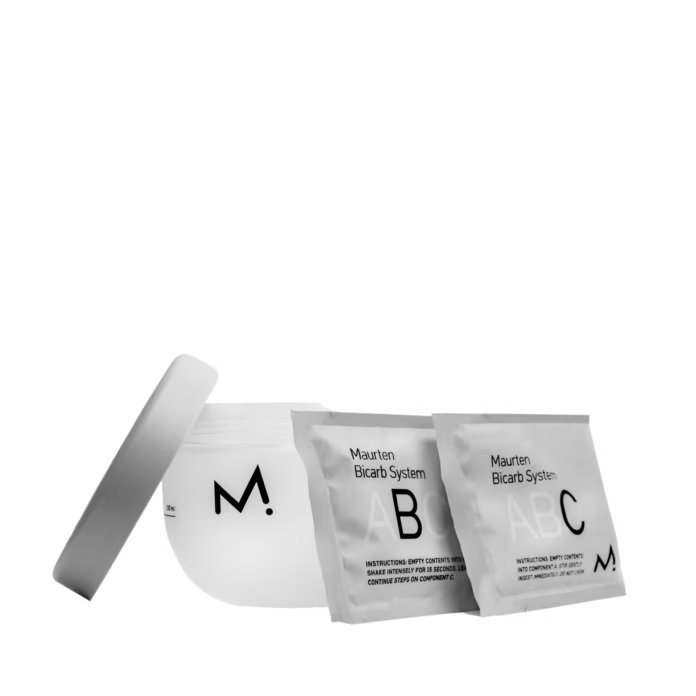
The Maurten Bicarb System combines sodium bicarbonate with a hydrogel-based delivery mechanism designed to transport bicarbonate through the stomach and release it in the small intestine.
The objective is simple: reduce gastrointestinal distress, improve absorption, create a more stable. buffering response. The system consists of a hydrogel mixture, bicarbonate micro-tablets, a timed ingestion protocol. Athletes mix the hydrogel with water, add the bicarbonate tablets, and consume the solution approximately 2–3 hours before training or racing.
One of the key developments, as discussed with Josh Rowe, is not just tolerability—but predictability. A more controlled delivery allows for a more consistent physiological response, which is critical in both training and competition.
The Science: Why Buffering Matters
At higher exercise intensities, the body accumulates hydrogen ions (H⁺), lowering pH and creating a more acidic muscular environment.
This increasing acidity—not lactate itself—is a primary contributor to fatigue.
As pH drops: muscle contraction becomes less efficient, force production declines, enzymatic activity is impaired, fatigue accelerates. The body naturally regulates this through buffering systems, one of which is bicarbonate.
When sodium bicarbonate is ingested, blood bicarbonate levels rise, increasing extracellular buffering capacity and allowing the body to better neutralize hydrogen ions. The commonly studied dosage is 0.3\ \mathrm{g/kg\ body\ weight}. For most runners, that translates to approximately 15–25 grams. This is a significant amount—and historically, one of the reasons bicarbonate has been difficult to use.
Why Traditional Bicarbonate Use Was Limited
Before modern delivery systems, bicarbonate was typically consumed in: powder form (baking soda), capsules. The issue is that bicarbonate reacts immediately in the stomach’s acidic environment. This reaction produces carbon dioxide gas, leading to: bloating, burping, cramping, gastrointestinal distress.
As Josh Rowe explained, athletes were often balancing potential performance gains against the risk of severe GI issues—something that made it unreliable, especially in competition settings.
The Role of Hydrogel Delivery
The key innovation lies in controlling where bicarbonate is released.
Hydrogel technology allows the bicarbonate to pass through the stomach with minimal interaction before being released in the small intestine, where absorption occurs more effectively.
This approach aims to: reduce gastric disruption, improve uptake efficiency, extend the duration of elevated bicarbonate levels.
The concept mirrors controlled-release systems used in pharmaceutical science, where the timing and location of absorption are critical to effectiveness.
This shift—from ingredient to delivery—is a broader trend in endurance nutrition.
What Types of Runs Is It For?
Traditionally, bicarbonate supplementation has been associated with middle-distance racing, high-intensity intervals, or repeated sprint efforts. However, its use is now expanding into endurance running.
According to Josh Rowe, athletes are increasingly experimenting with bicarbonate in threshold sessions, double-threshold training, long marathon workouts, marathon racing, and ultra-endurance events.
Even in a marathon, runners encounter repeated periods of elevated intensity: hills, surges, pace variability, and cumulative fatigue. In these scenarios, buffering capacity may help maintain output under fatigue, stabilize effort, or tolerate prolonged intensity.
Rather than simply increasing speed, the potential benefit appears to lie in sustaining performance deeper into fatigue.
Who Is It For?
Bicarbonate supplementation is most relevant for competitive runners, elite and sub-elite marathoners, advanced amateurs, athletes training near or above lactate threshold, middle-distance athletes, cyclists, and rowers.
It is not a foundational tool. Core performance factors remain more important consistent training, proper fueling, recovery, sleep. As discussed, bicarbonate functions more as a marginal gain—something layered on top of an already well-developed system.
How Is It Taken in Practice?
In practical use, the system is designed to be taken before a key session or race, not during. Athletes typically consume it 2–3 hours prior to exercise, allowing time for bicarbonate levels in the blood to rise and reach an effective range. The process involves mixing the hydrogel solution with water, adding the bicarbonate micro-tablets, and ingesting the mixture in one serving—without chewing the tablets. It is generally recommended to take it alongside a light meal or snack rather than on an empty stomach to further reduce the risk of gastrointestinal discomfort. Once absorbed, elevated bicarbonate levels can remain for several hours, creating a relatively wide performance window that athletes can align with their training session or race start.
What Does the Research Say?
While sodium bicarbonate has long been studied, research specifically examining hydrogel delivery systems is still emerging.
However, several peer-reviewed studies involving this approach have now been published:
- 40 km Cycling Time Trial Study
Found improved time trial performance alongside increased buffering capacity. - Buffering and GI Symptom Study
Reported improved bicarbonate kinetics and reduced gastrointestinal distress. - Repeated High-Intensity Cycling Study
Examined repeated performance under high-intensity conditions. - Endurance Running Study
Found minimal GI distress in runners, though performance outcomes were not significantly different.
Most of the current research has been conducted in cycling populations, in controlled lab environments, over shorter durations.
Which means marathon-specific evidence is still developing.
The Bigger Picture: Delivery Science
What makes this conversation particularly relevant is not just bicarbonate itself—but what it represents. Endurance performance is increasingly influenced not only by what is consumed, but also by how it is delivered, where it is absorbed, how consistent the physiological response is.
Hydrogels, controlled-release systems, and absorption-focused strategies are becoming central themes in performance nutrition.
Final Thoughts
Sodium bicarbonate is not a new discovery. What appears to be changing is the ability to apply it consistently and effectively in real-world training and racing environments.
The science behind buffering and pH regulation has been established for decades. The current focus is on improving tolerability, predictability, and application.
And in endurance sport—where performance is built on the accumulation of small advantages—those improvements may matter more than any single breakthrough.