

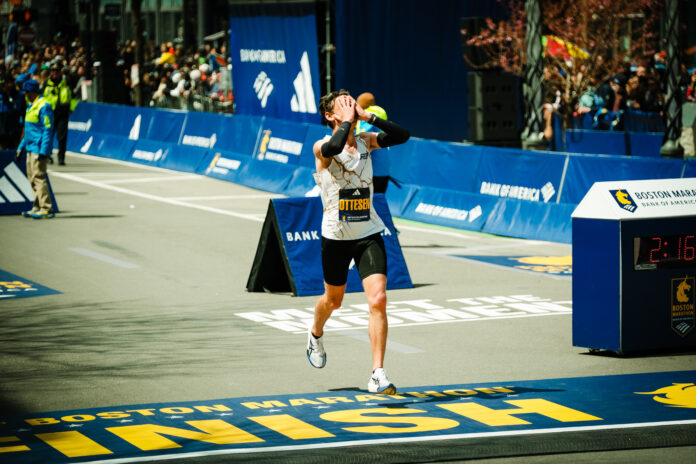
In the high-stakes, hyper-quantified world of modern marathoning, it’s easy to get lost in lactate thresholds, shoe foam densities, and pristine pacing charts. But when you strip away the social media highlight reels, distance running remains a raw exercise in human spirit, resilience, and sheer grit. For this week’s segment of “Your Story, Your Why,” Utah-based marathoner, content creator, and mechanical engineer Michael Ottesen opened up about the deep childhood origins of his high pain tolerance, his grueling journey as an unrecruited walk-on, and why heartbreaking near-misses only fuel his fire to keep pushing.
The Art of Outsuffering the Field
Michael’s journey in endurance sports didn’t begin with prodigal talent or effortless speed. As a 12-year-old entering junior high track and cross country, he quickly realized he wasn’t the fastest kid on the line. What he possessed instead was a distinct, mature psychological edge: an uncanny ability to endure physical discomfort longer than his peers.
“I was not very talented, but I did like it a lot,” Michael reflects. “I learned at a very early age that I was good at pushing through and, for lack of a better term, suffering for a longer time than my peers were… I always knew that if I worked harder or was willing to hurt a little longer, it would pay off.”
He first discovered this talent during an elementary school walk-a-thon. While other kids sprinted out wildly in the opening minutes to collect pledge laps, young Michael paced himself methodically. As his classmates faded under the heat and fatigue, he steadily reeled them in, ultimately completing the most laps on the track simply by outlasting everyone else.
Four Years of Unwavering Belief
That willingness to embrace the grind became the defining theme of his collegiate pursuit. In high school, Michael set his sights on running for Brigham Young University—a powerhouse program led by former Olympian Ed Eyestone. Unrecruited and largely ignored by coaching staff, he enrolled at BYU purely as a student with the dream of walking onto the cross country and track teams.
What followed was a four-year test of faith and patience. After failing his initial tryout, Michael spent two years serving a church mission in France with almost no running, returned home out of shape, spent another full year rebuilding his fitness, and failed a second attempt. It wasn’t until his fifth year at the university that he finally earned a spot on the NCAA roster, eventually competing for three seasons while earning his degree in mechanical engineering.
When asked how he kept going through years of rejection, Michael points directly to his parents. His mother kept him grounded with a simple, powerful mantra: “Why not you?” Meanwhile, his father—a former college football player who regretted stepping away from sports too early—offered to cover his tuition on one condition: that Michael focus solely on being an athlete without taking a job.
“My dad always said you only get one chance to be an athlete since you can’t go back in time,” Michael recalls. “Sometimes that naivete—just not knowing how hard it’s going to be—is what allows you to achieve greater things because you have the belief that you can be great.”
The Heartbreak of Single-Digit Seconds
Transitioning from NCAA track races to the marathon was an immediate reality check. At the 2021 California International Marathon, Michael hit the wall so hard in the final 10K that he faded to a 2:23 and spent 45 minutes in the medical tent. Rather than turning him away, the catastrophe hooked him.
By October 2023, targeting the 2:18:00 Olympic Trials Qualifying (OTQ) standard at the McCurdy Micro Marathon, Michael hit mile 20 feeling strong before severe calf cramps locked his legs. Limping across the finish in 2:18:55, he missed the OTQ standard by just 55 seconds.
When USATF lowered the standard to 2:16:00 for the next cycle, Michael raised his standards accordingly. At the 2024 Boston Marathon, he ran in the lead packs and hit the half-marathon mark in 65 minutes, maintaining a sub-2:12 pace through Newton. But just before mile 24, his right hamstring completely seized. After stopping for two agonizing minutes to stretch and limping down Boylston Street, he sprinted across the line in 2:16:06—missing the Olympic Trials standard by an agonizing six seconds.
Balancing the Grind
What makes Michael’s pursuit so captivating isn’t just the drama on Boylston Street; it’s the reality of his everyday life. Working full-time as a mechanical engineer for a medical device company with a long daily commute, he balances 100-plus-mile training weeks alongside raising two young children with his wife. His routine frequently requires 4:30 AM workouts in the pitch black and squeezed-in lunch runs between engineering meetings.
Far from being discouraged by those six seconds, Michael remains extremely confident in his trajectory as he prepares for the St. George Marathon and a return to CIM. He has also partnered with Olympian Rory Linkletter to launch Let’s Tango Running, a personalized 1-on-1 coaching platform.
“I constantly feel like I’ve got a chip on my shoulder and something to prove,” Michael says with a smile. “I don’t know how to do running at a half effort. I just love it so much.”
Marathoners are a unique breed. As Michael reminds us, the willingness to step back onto the line after a devastating setback isn’t about guaranteed success—it’s about the relentless belief that you can push your limits just a little bit further.
What resonated most with you from Michael’s journey—was it his perspective on embracing the ‘dark miles’ of suffering, or how he balances a demanding engineering career and family with elite training?