

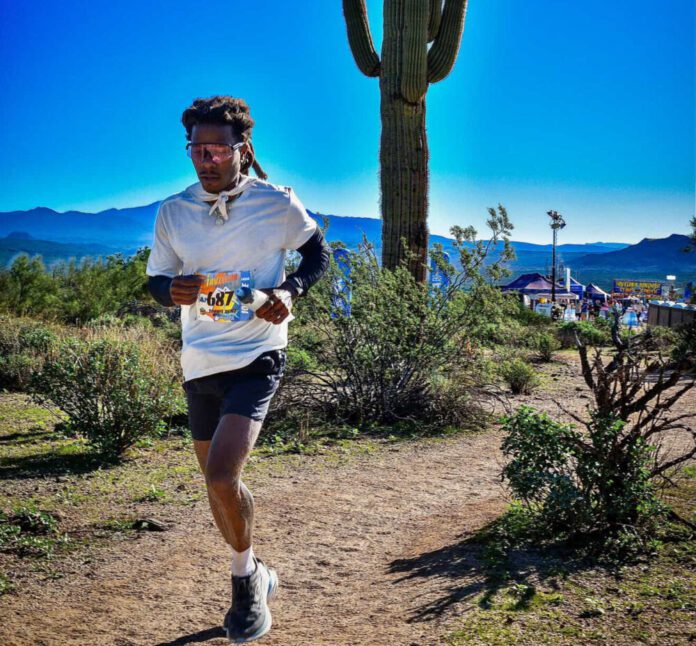
Photo Credits: Courtesy of Tommie Runz
Marathoners are taught to trust numbers.
Pace per mile.
Heart rate zones.
Fueling intervals.
Splits that confirm whether the day is unfolding as planned.
Over time, those numbers become more than tools — they become identity. Proof of preparedness. Reassurance that suffering is proceeding on schedule.
Ultra-distance trail racing strips that comfort away.
At the Javelina 100, a five-loop desert ultra in Arizona, Tommie Runz entered with fitness, ambition, and a clear objective: finish under 18 hours and secure a qualifying time for Western States 2026. He also entered with something many marathoners unknowingly carry into trail racing — the belief that discipline on the road translates cleanly into control on the trail.
It doesn’t.
What unfolded across those 100 miles was not a failure of preparation, but an exposure of assumptions — about pacing, fatigue, resilience, and what endurance actually demands once the finish line stops being imminent.
The Seduction of Road Math
The first mistake most marathoners make when contemplating an ultra is not physical — it’s mathematical.
Tommie’s sub-18-hour goal translated to roughly 3:30 per loop. On paper, that felt reasonable. He had the aerobic base. He had the mileage. He had already completed extreme endurance challenges, including The Speed Project Solo — a 340-mile effort that demanded sustained movement and mental resilience.
But math assumes consistency.
Trail racing introduces variables that erode consistency almost immediately: uneven footing, soft surfaces, repeated accelerations, prolonged heat exposure, and the subtle tax of constant attention. Unlike the road, where pace is externally regulated by terrain, the trail forces internal regulation — and mistakes compound quietly.
“I had this number in my head,” Tommie says, “but I didn’t really know what it meant pace-wise” .
This is where road speed becomes a liability. Marathoners are accustomed to interpreting ease as permission. In ultras, ease is often a trap.
Energy Control as a Survival Skill
One of the more revealing moments in Tommie’s experience occurred before the race began.
Despite the high-energy atmosphere surrounding Javelina, he intentionally lowered his emotional intensity. Headphones in. Minimal conversation. Conserved excitement.
This wasn’t accidental.
For Tommie, racing — regardless of distance — is about controlling energy, not just output. That philosophy, honed on the road, became essential on the trail.
“The main part of racing any distance,” he reflects, “is controlling where you start from”.
Many marathoners struggle here when transitioning to ultras. The early miles feel forgiving. The pace feels conversational. The excitement masks cost. Energy leaks out not through speed, but through emotional overinvestment.
At Javelina, Tommie resisted that urge — and still paid a price later.
The Second Loop: Where Confidence Cracks
By the second loop — somewhere between 20 and 40 miles — the race revealed itself.
The heat rose. The terrain demanded more than anticipated. Tommie’s legs felt heavy in a way that defied comparison to anything he’d experienced in road racing.
“I was looking forward to the third or fourth loop being the hardest,” he says. “But the second loop was just incredibly heavy”.
This moment is critical for marathoners to understand.
On the road, discomfort typically escalates in a predictable arc. Ultras fracture that arc. Fatigue can spike early, recede, and return transformed. The body doesn’t negotiate — it informs.
The most destabilizing realization wasn’t how bad it felt. It was how early it felt bad — paired with the knowledge that most of the race still lay ahead.
“There’s no way I could do this,” Tommie remembers thinking. “If this gets worse, I’m done”.
That thought is not weakness. It’s honest appraisal — and it’s where many runners quit.
The Difference Between Preparation and Belief
What prevented Tommie from stepping off the course wasn’t blind optimism. It was something more durable.
He knew the work was done.
He knew the miles weren’t skipped.
The training wasn’t rushed.
The preparation wasn’t performative.
“You have to know you didn’t cut any corners,” he explains. “That’s what gives you something to stand on”.
For marathoners, this is a subtle but crucial distinction. Training often focuses on fitness markers — long run distance, pace targets, weekly volume. Ultra racing exposes whether preparation also included mental permission to suffer without reassurance.
Belief doesn’t come from hoping things improve. It comes from evidence you built beforehand.
Loop Three and the Collapse of Time
If loop two cracked confidence, loop three dismantled time itself.
Tommie describes frustration, emotional exhaustion, and an inability to see beyond the immediate moment. This cognitive narrowing is common in prolonged endurance events, particularly under heat stress.
What helped him persist was a framework borrowed from outside running entirely: one step at a time. One moment at a time.
“There was nothing fancy about it,” he says. “Just get through this one”.
This reduction of scope is something marathoners rarely practice — because they rarely need to. Ultras demand it.
Why Running With Someone Matters More Than Pace
During that same loop, Tommie found himself running with Andrew, another competitor experiencing the same struggle at the same speed.
They didn’t strategize.
They didn’t coach each other.
They simply moved forward together.
That mattered.
Sharing effort reduces mental load. Decision-making becomes communal. Suffering feels less isolating. Tommie describes it as “collective misery,” but the effect was stabilizing and restorative.
Interestingly, he connects this back to road racing — noting that some of his strongest marathons came when he settled into a group instead of chasing time alone.
Ultras expose a truth marathoners often resist: independence is not always efficiency.
Maintenance Is Performance
By loop four, the race shifted.
Not because pain disappeared — but because resistance to pain did.
“No feeling bad for yourself,” Tommie recalls. “Just move forward”.
One of the most effective interventions came from a simple act: changing shirts.
After hours of desert heat, fresh clothing reset his nervous system. Sensory relief translated into renewed focus. It was a reminder that ultra racing is less about toughness and more about maintenance.
Road runners often underestimate this. Minimalism works when exposure is short. Over 100 miles, neglect compounds.
Shoes, Swelling, and the Reality of Duration
Tommie ran all 100 miles in a single pair of HOKA Rocket X Trail shoes — but preparation made that possible. He trained extensively in them and sized up a full size to account for swelling, rather than the half-size adjustment common in road racing.
This choice reflects a broader lesson: trail racing demands respect for inevitability. Feet will swell. Skin will break down. Ignoring that reality doesn’t make you resilient — it makes you fragile.
The Role of an Outrageous Goal
From the start, Tommie framed Javelina as a reach.
A first 100-mile race.
A Western States qualifier.
An 18-hour target.
“I thrive in those moments,” he says, where the goal feels almost unreasonable.
That goal didn’t disappear when things unraveled. It became the thread that pulled him forward — not as pressure, but as purpose.
“When times get tough,” he reflects, “all we have is our goals and the work we put in prior”.
The Finish Line as Recognition, Not Relief
By the final loop, Tommie’s body was finished arguing. The task was simple: close it out.
As the finish approached, emotion surfaced — not joy, but recognition. Friends appeared. The effort suddenly had witnesses.
Crossing the line wasn’t about completion. It was about legitimacy.
“You earn this,” he recalls thinking. “Therefore you deserve it. Therefore you belong”.
What Marathoners Should Take From This
You don’t need to run 100 miles to learn from this story.
But if you’re a marathoner — especially one flirting with longer distances — Tommie Runz’s experience offers a warning and an invitation.
Fitness does not scale cleanly.
Pacing is not protection.
And endurance is not a feeling — it’s a decision repeated long after confidence fades.
Whether your next race is on asphalt or desert dirt, the lesson remains:
Preparation creates belief.
Belief enables persistence.
And belonging is earned when quitting finally makes sense — and you don’t.
Tommie Runz is a road-to-ultra endurance athlete and storyteller whose work explores the edges of performance, identity, and resilience. Known for taking on ambitious, often uncomfortable endurance challenges, he brings a marathoner’s discipline into the ultra-distance world while documenting the mental and emotional realities of long-form suffering. Tommie shares his journey and conversations on endurance, creativity, and recovery through his podcasts and social platforms.
You can find him on Instagram at @tommie_runz, and through his podcasts @the.pr.project, @thetommierunzshow, and @relay_site.