

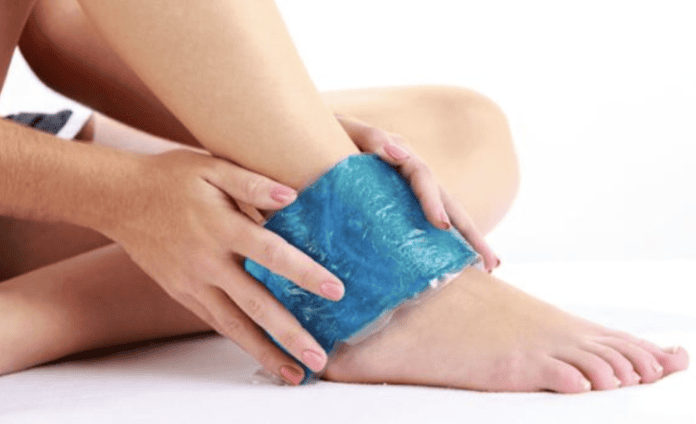
For decades, the advice was simple: sprain your ankle, pull a muscle, or tweak your knee, and the first thing you should do is RICE it.
- Rest
- Ice
- Compression
- Elevation
It was taught in first aid courses, recommended by physicians, repeated by coaches, and passed down by generations of athletes. For many runners, grabbing an ice pack after an injury became almost automatic.
But in recent years, sports medicine has begun asking an important question: Have we been confusing symptom relief with better healing?
The answer isn’t as simple as “ice is bad.” In fact, the science tells a much more interesting story.
Where Did RICE Come From?
The RICE protocol was introduced in 1978 by sports medicine physician Dr. Gabe Mirkin in The Sportsmedicine Book. The logic made perfect sense: an injury causes inflammation, swelling causes pain, and reducing swelling should help recovery.
For decades, this approach became the gold standard for treating sprains, strains, and other soft-tissue injuries.
The Role of Inflammation
One of the biggest shifts in sports medicine over the last two decades has been our understanding of inflammation. For years, inflammation was viewed as the enemy. Today, researchers recognize that it is a normal and necessary part of the healing process.
When tissue is injured, the body doesn’t simply become inflamed—it begins repairing itself. Immune cells migrate to the damaged area, remove injured tissue, release chemical signals, and initiate the rebuilding process.
The Shift: Inflammation isn’t just responsible for swelling and soreness. It’s also one of the body’s first steps toward recovery.
Even the Creator of RICE Changed His Mind
One of the most surprising developments came from Dr. Gabe Mirkin himself. Years after introducing RICE, Mirkin publicly acknowledged that newer research had changed his thinking. He explained that while ice can certainly reduce pain, the available evidence does not clearly demonstrate that it speeds tissue healing. In fact, he noted that suppressing inflammation may interfere with some of the body’s natural repair mechanisms.
That doesn’t mean ice has no value. It means we need to distinguish between feeling better and healing better. Those two things are not always the same.
What Does the Evidence Show?
- The Bleakley Research: A review of 22 randomized controlled trials examining cryotherapy (ice) for acute soft-tissue injuries concluded that the overall quality of the evidence was limited. A later trial involving 89 patients with acute ankle sprains found that intermittent icing improved pain during activity, but it did not produce major differences in swelling, pain at rest, or overall function one week after injury.
- The 2012 Systematic Review: This paper evaluated 11 randomized controlled trials involving 868 patients and concluded there was insufficient evidence to determine whether the complete RICE protocol was effective for treating acute ankle sprains.
- The 2024 Review: A clinical commentary published in the Journal of Contemporary Chiropractic reviewed 43 scientific sources. The authors found that while ice appears effective for reducing pain and discomfort, there is limited evidence that icing improves long-term healing outcomes.
The Biology
Experimental studies show that cooling can reduce blood flow, alter inflammatory cell activity, and influence biological processes involved in tissue repair. Some of these studies suggest that icing may delay certain aspects of muscle regeneration.
Note: Many of these mechanistic studies have been performed in animals. While they help scientists understand how healing works, animal studies cannot automatically be applied directly to humans.
The Parallel Debate: Ibuprofen and Training Adaptations
Interestingly, this discussion mirrors another debate occurring in sports medicine: the routine use of anti-inflammatory medications (NSAIDs) like ibuprofen after exercise.
Many runners automatically reach for ibuprofen after a marathon or difficult training session. The reasoning sounds identical: muscles are sore, inflammation is present, so we should reduce the inflammation to recover faster.
But researchers are beginning to ask whether routinely suppressing inflammation after training might interfere with the body’s natural adaptation process:
[Exercise Stress] ➔ [Controlled Inflammation] ➔ [Repair Pathways] ➔ [Stronger Muscles]
Several studies suggest that routinely blocking inflammation may influence some training adaptations. This doesn’t mean runners should never take ibuprofen; it simply reinforces the same lesson emerging from the ice debate: reducing symptoms is not always the same as improving recovery.
The Takeaway for Runners
Sports medicine is constantly evolving. The goal isn’t to prove that yesterday’s advice was wrong—it’s to improve tomorrow’s care.
The RICE protocol helped shape decades of injury management, but our understanding of inflammation has changed. Today’s evidence suggests that while ice remains useful for pain relief, recovery is far more complex than simply reducing swelling.
For runners, the takeaway is simple: focus on supporting your body’s natural healing process, follow a progressive rehabilitation plan, and don’t mistake feeling better for being fully recovered. Science doesn’t stand still—and neither should our approach to recovery.
Myth vs. Fact
- Myth: Ice speeds healing.
- Fact: Current evidence supports ice for pain relief, but evidence that it improves healing is limited.
- Myth: Inflammation is always bad.
- Fact: Inflammation is one of the body’s natural responses that helps initiate tissue repair.
- Myth: If it doesn’t hurt anymore, it’s healed.
- Fact: Pain often improves before tissues have fully recovered.
- Myth: RICE has been completely disproven.
- Fact: Sports medicine has evolved. The role of ice is being reconsidered, while compression, elevation, protection, and progressive rehabilitation remain important parts of injury management.
References
- Bleakley CM, McDonough SM, MacAuley DC. (2004). The use of ice in the treatment of acute soft-tissue injury: A systematic review of randomized controlled trials. American Journal of Sports Medicine, 32(1), 251–261.
- Bleakley CM, McDonough SM, MacAuley DC. (2006). Cryotherapy for acute ankle sprains: A randomized controlled study of two different icing protocols. British Journal of Sports Medicine, 40(8), 700–705.
- van den Bekerom MPJ, et al. (2012). What is the evidence for rest, ice, compression, and elevation therapy in the treatment of ankle sprains in adults? Journal of Athletic Training, 47(4), 435–443.
- Dubois B, Esculier JF. (2020). Soft-tissue injuries simply need PEACE & LOVE. British Journal of Sports Medicine, 54(2), 72–73.
- Horschig A, Sonthana K, Williams B, Horgan M, Starrett K. (2024). The Efficacy of Icing for Injuries and Recovery: A Clinical Commentary. Journal of Contemporary Chiropractic.