New York Road Runners (NYRR) announced a major expansion of its sustainability programming for the upcoming 2026 TCS New York City Marathon. For the first time in the event’s 50-year history on the five-borough course, self-serve filtered water refill stations will debut directly along the route.
Crucially for runners: Traditional paper cups are not going away.
The new refill hubs represent a hybrid pilot system—offering dedicated, fast-flow hydration options for athletes carrying their own handheld bottles, soft flasks, or vests, while keeping the marathon’s standard cup-based aid stations fully operational across all 26.2 miles.
What the New System Means on Race Day
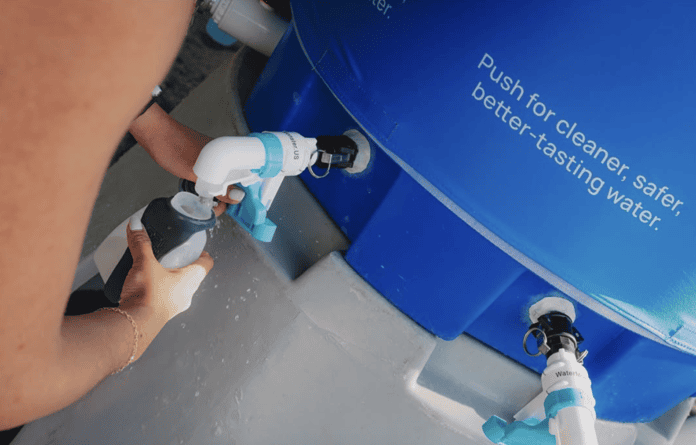
Developed in partnership with Culligan International, NYRR’s Official Water Solutions Partner, the five new self-serve refill hubs will be positioned across all five boroughs at Miles 8, 14, 17, 20, and 23, optimized for rapid run-in/run-out filling of soft flasks and hydration vests.
Traditional Fluid Stations (25 Stations): Full-service tables offering paper cups of Water and Gatorade Endurance, with all cups collected for post-race composting (107.99 tons processed in 2025).
Rather than replacing traditional paper cups, these five stations complement the race’s 25 standard fluid stations. They are built specifically for run-in/run-out access for runners using handheld bottles, hydration belts, or vests. Using high-capacity activated carbon filtration, the Culligan units deliver filtered water at high flow rates to minimize microplastics and improve taste without creating course bottlenecks.
To support this shift toward reusable gear, NYRR has also partnered with HydraPak as an official licensee to launch co-branded reusable bottles and soft flasks, making it easier for participants to train and race with self-carried hydration.
“Reducing the environmental impact of an event the scale of the TCS New York City Marathon requires new ideas and thoughtful partnerships,” said Rob Simmelkjaer, CEO of New York Road Runners. “By working alongside Culligan International, HydraPak, and our other partners, we can introduce practical solutions that make a difference on race day while encouraging more sustainable habits that extend well beyond the finish line.”
The rollout aligns with NYRR’s long-term environmental target to achieve Net Zero emissions by 2040.
Industry Context: Testing, Not Forcing, the Transition
NYRR’s approach mirrors a growing trend across the World Marathon Majors (WMM): using hybrid pilot tests to evaluate logistics before making sweeping operational changes.
While the Paris Marathon made waves by going completely cupless and eliminating disposable cups entirely, major U.S. events are adopting a more gradual strategy.
Different World Marathon Majors are approaching the transition in distinct ways:
- Paris Marathon: Went fully cupless, completely eliminating disposable cups and transitioning to reusable flasks.
- Bank of America Chicago Marathon & Chicago 13.1: Implemented an on-course refill station pilot while retaining traditional paper cups to test flow and logistics.
- TCS New York City Marathon: Introduced five-borough Culligan refill hubs while keeping all 25 standard cup stations fully operational for a hybrid approach.
As previously reported in Marathon Journal’s analysis on cupless racing in Chicago, major marathons consume upwards of 2 million cups per race weekend, with athletes using 3 to 4 cups per aid station.
However, forcing a rapid change brings potential concerns around aid station congestion, flow rates, and runner preferences. By introducing refill hubs alongside standard fluid tables, organizers in Chicago and New York can test real-world flow rates and collect runner feedback without impacting race-day execution.
Broader 2026 NYC Marathon Sustainability Initiatives
The hydration test is one component of NYRR’s broader race-week sustainability programming:
- NYRR Team for Climate: In its third year, 200 accepted runners will participate via a dedicated climate experience. Since launching in 2024, the team has raised over $1.9 million ($650,000 during 2025 alone) to fund carbon offsetting and insetting projects.
- Waste Diversion & Recycling: 130 Green Team volunteers will staff 9 Waste Diversion Stations to help sort waste. In 2025, NYRR diverted 152.81 tons of recyclable material and composted 107.99 tons of drink cups through McEnroe Farms.
- Charity Donations: Leftover food will be donated to City Harvest (17,620 lbs in 2025), while discarded start-line clothing will go to All of Us Clothing (123,000 lbs in 2025).
- Zero-Emission Fleet: Official partner Volvo will supply an electrified lead and support fleet, including 5 all-electric EX60 lead vehicles, 11 EX90 electric support vehicles, and 10 XC90 hybrid vehicles.
- Climate Week NYC Panel: On Tuesday, Sept. 22, NYRR will host its 4th annual Climate Week NYC panel, “Perspectives Shaping Climate Action Through Sport,” at the NYRR RUNCENTER featuring speakers from Culligan, sports, and media, followed by a community plogging run.
Conclusion: The Incremental Path to Sustainable Racing
The debut of Culligan refill stations at the TCS New York City Marathon signals a deliberate, measured shift in how world-class endurance events tackle environmental impact. Rather than forcing immediate behavioral shifts on 60,000 runners through top-down mandates, NYRR is building out the necessary infrastructure—and offering tangible incentives through HydraPak partnerships—to let runners opt in naturally.
As major World Marathon Majors like New York and Chicago gather operational data from these pilot stations, the hybrid aid station is quickly establishing itself as the pragmatic bridge between traditional race logistics and a lower-waste future. Whether these refill hubs eventually replace paper cups altogether will ultimately depend on runner adoption, station throughput, and course flow—but for now, the option to race cupless on the streets of New York is officially open.